
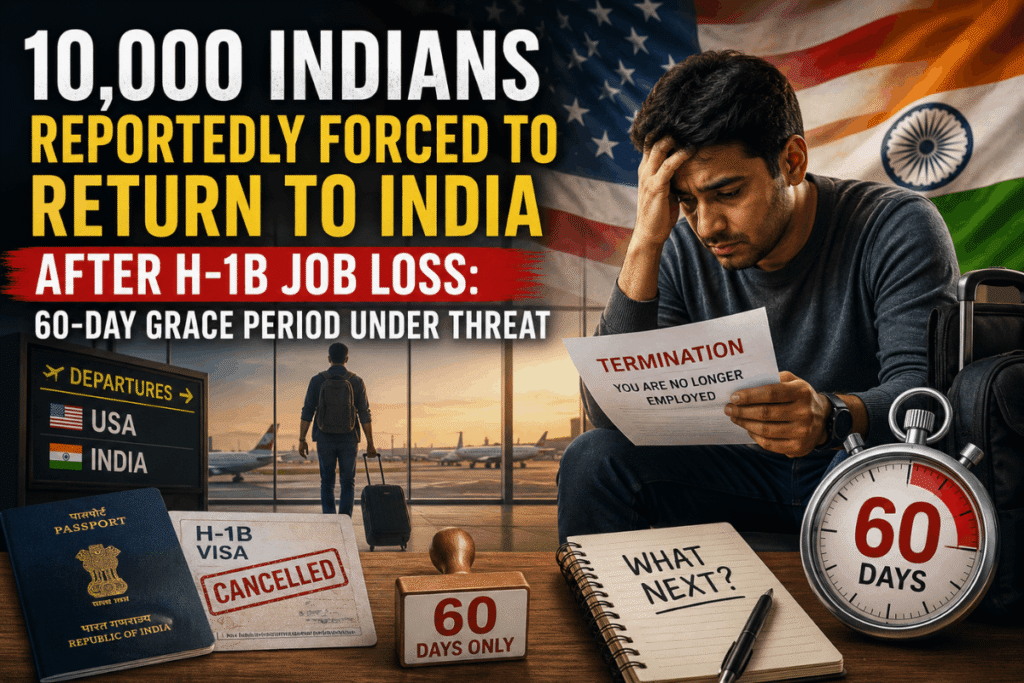
H-1B Visa Latest News 2026: Indian professionals working in the United States are facing fresh uncertainty as the Trump administration moves to change the rules surrounding the H-1B visa. Around 10,000 Indian H-1B professionals have reportedly returned to India after losing their jobs and failing to secure new employment within the permitted period, according to reports.
The reported figure is significantly higher than the approximately 5,100 Indian professionals reported to have left the US during the previous year. However, this 10,000 figure should be treated as a reported estimate rather than a number independently confirmed in publicly available USCIS data.
The bigger concern for H-1B workers is now the future of the 60-day grace period. The Department of Homeland Security (DHS) has proposed eliminating the discretionary grace period that currently gives eligible H-1B and certain other employment-based nonimmigrant workers up to 60 days after employment ends to find another employer, change status or make arrangements to leave the country. The proposal cleared White House regulatory review on August 27, 2026, but it has not yet become a final rule.
H-1B Visa Crisis: Why Indian Professionals Are Worried
The H-1B visa is one of the most important US work-visa routes for highly skilled foreign professionals, particularly in technology, engineering, research and other specialty occupations.
Indian professionals are especially exposed to changes in the H-1B system because they represent a very large share of approved H-1B beneficiaries. According to recent reporting based on US government data, people born in India accounted for approximately 71% of approved H-1B petitions in fiscal year 2024.
At the same time, parts of the US technology sector have experienced layoffs and slower foreign hiring.
For example, recent federal filing data showed that Google’s approved H-1B hires fell to approximately 2,200 from around 5,100 a year earlier, while Amazon’s approvals declined to about 4,300 from approximately 6,100.
This combination of layoffs, tougher immigration policies and greater difficulty in finding employers willing to sponsor H-1B workers is creating additional pressure on Indian professionals.
What Happens When an H-1B Worker Loses a Job?
The Current 60-Day Grace Period
Under the existing regulations, eligible H-1B workers who experience termination may receive an up-to-60-day grace period, or until the end of their authorised validity period if that occurs sooner.
The rule is not simply a guarantee of 60 days of employment. Rather, it provides a limited period during which the worker can take steps to protect their immigration status.
USCIS has previously explained that affected workers may explore options such as finding a new H-1B employer, filing for another immigration status or making arrangements to leave the United States.
Also Read: UP Scholarship Start 2026-27: Registration
Finding a New Employer
The most obvious option is to secure another employer willing and able to file the required H-1B petition.
This can be difficult during a period of layoffs because employers may reduce hiring or become more cautious about immigration sponsorship.
Changing Immigration Status
Depending on individual circumstances, some workers may have other immigration options. USCIS has previously highlighted that certain workers may be able to pursue another nonimmigrant status or other qualifying immigration filings within the relevant period.
However, eligibility depends on the individual’s circumstances. A worker should not assume that every alternative visa will automatically be available.
Leaving the United States
If a worker cannot obtain another qualifying status or employment arrangement, leaving the US before the authorised stay expires may be necessary.
The key point is that losing an H-1B job does not automatically mean immediate deportation. The worker’s specific immigration status, authorised stay and actions taken after termination all matter.
Trump Administration Moves to Remove the 60-Day Safety Net
The latest development is a DHS proposal titled “Eliminating the Discretionary 60-day Grace Period.”
According to the federal regulatory record, the proposal was submitted for review on August 6, 2026, and the Office of Information and Regulatory Affairs (OIRA) concluded its review on August 27.
But there is an important distinction:
The 60-day grace period has not been abolished yet.
The proposal is still part of the federal rulemaking process. It would have to move through the required regulatory steps before any final change takes effect. Recent immigration reporting has also stressed that workers should continue following the existing rules until an actual final rule changes them.
Is Trump Removing the 60-Day Grace Period Immediately?
No — Not Yet
Claims that the 60-day grace period has already been cancelled are premature.
The current situation is:
- DHS/USCIS proposed eliminating the discretionary grace period.
- The proposal underwent White House regulatory review.
- OIRA concluded its review on August 27, 2026.
- The proposal still needs to proceed through the rulemaking process.
- Until a final rule takes effect, the existing framework remains applicable.
This distinction is extremely important for H-1B workers because a proposal and a final immigration rule are not the same thing.
What If the 60-Day Grace Period Is Eventually Removed?
If the proposal becomes a final rule substantially as described, losing an H-1B job could become much more urgent.
A worker could have significantly less time to:
- Find a new sponsoring employer
- File an appropriate immigration application
- Explore another lawful status
- Arrange relocation
- Prepare financially for departure
- Consult an immigration attorney
The practical impact could be particularly serious for workers with families, mortgages, school-age children or long-term commitments in the US.
It could also increase pressure on workers to accept employment opportunities quickly, even when those jobs may not be ideal for their career.
Why the Situation Is Particularly Difficult for Indians
Indian professionals are disproportionately represented in the H-1B system. Therefore, any major change affecting H-1B workers is likely to have a particularly large impact on Indian technology and skilled professionals.
Another issue is the long-term immigration situation of many Indian workers.
Many Indian professionals remain on temporary employment visas for extended periods while pursuing employment-based permanent residency. This can make sudden job loss more disruptive than it would be for a worker who already has permanent resident status.
Therefore, the issue is not simply about finding another job.
It can become a question of whether the worker can legally remain in the country while searching for that job.
US Tech Hiring Is Not Completely Closed
Despite the difficult environment, it would be incorrect to say that all US companies have stopped hiring H-1B professionals.
Nvidia, for example, has continued to expand H-1B hiring while several other major technology companies have reduced approvals. Federal filing data cited in recent reports showed Nvidia securing certification for around 1,200 H-1B positions during the first two quarters of fiscal 2026, compared with roughly 1,000 during the comparable period a year earlier.
This shows that the US job market is changing rather than disappearing completely.
Professionals with strong skills in areas such as artificial intelligence, semiconductor technology, cybersecurity, cloud computing, data engineering and specialised software may still find opportunities.
What Should H-1B Workers Do to Stay Stable?
1. Start Job Searching Before a Layoff
H-1B workers should not wait until the final weeks of the grace period to begin looking for another employer.
Keeping an updated resume, LinkedIn profile, professional network and list of potential sponsors can make the transition faster.
2. Build Skills That Are in Demand
Technology professionals should focus on skills that remain valuable despite changes in hiring.
AI, machine learning, cybersecurity, cloud infrastructure, semiconductor engineering, data science and specialised software engineering can offer stronger opportunities than relying on a single employer or technology stack.
3. Maintain an Emergency Fund
Visa-related job loss can create expenses for legal advice, relocation, flights, housing and other urgent needs.
An emergency fund can give workers more flexibility during an unexpected termination.
4. Understand Immigration Options Before a Crisis
Workers should understand their possible immigration pathways before losing employment.
Because immigration eligibility depends on individual circumstances, professional legal advice can be important before filing any change-of-status or employment-based petition.
5. Consider a Backup Country
For professionals who want greater immigration stability, countries such as Canada, Germany and Australia may be worth researching as alternative destinations.
However, these countries do not offer automatic alternatives to H-1B status. Applicants must meet their own immigration requirements.
Canada: An Alternative for Skilled Professionals
Canada has several immigration pathways for skilled workers, although the special H-1B open work permit initiative launched in 2023 is now closed after reaching its 10,000-application cap.
Therefore, an H-1B professional should not assume that simply holding an H-1B visa makes them eligible for Canada’s previous special program.
Instead, candidates may need to evaluate Canada’s current skilled-worker, employer-specific or permanent-residence pathways based on their education, occupation, work experience, language ability and other factors.
Germany: Growing Interest Among Skilled Workers
Germany is another destination attracting international technology and skilled professionals.
The EU Blue Card is available to qualifying professionals with an eligible job offer and salary. For 2026, Germany lists a general minimum gross annual salary of €50,700, while a lower threshold of €45,934.20 applies to certain shortage occupations and eligible categories.
Germany also has other work-visa routes for qualified professionals and experienced workers.
Australia: Skilled and Employer-Sponsored Options
Australia also maintains several skilled migration and employer-sponsored routes.
Its current skilled migration system includes options such as the Skills in Demand visa (subclass 482), Employer Nomination Scheme visa (subclass 186), Skilled Independent visa (subclass 189), Skilled Nominated visa (subclass 190) and regional skilled pathways.
For example, the subclass 186 Employer Nomination Scheme can allow eligible skilled workers nominated by an Australian employer to live and work in Australia permanently.
This does not mean Australia is automatically easier than the US. Applicants still have to satisfy occupation, skills, English, sponsorship and other requirements.
What Is the Best Strategy for Indian H-1B Professionals?
The biggest lesson from the current H-1B uncertainty is not to depend entirely on one employer or one immigration pathway.
A stronger long-term strategy can involve:
US Job + Immigration Backup + Financial Backup + International Career Backup
For example, an H-1B professional can continue searching for US employment while simultaneously researching eligibility for Canada, Germany or Australia.
This approach does not mean abandoning the US.
Instead, it gives professionals more options if layoffs, sponsorship restrictions or immigration-policy changes affect their plans.
H-1B Visa Latest News 2026: What Happens Next?
The next major development will be the formal publication and subsequent rulemaking process for the DHS proposal to eliminate the discretionary 60-day grace period.
Until a final rule becomes effective, H-1B workers should not assume that the existing 60-day framework has disappeared.
The reported return of around 10,000 Indian professionals highlights the seriousness of the employment risk, but the number should be treated carefully because the exact figure has not been independently confirmed through a publicly available USCIS dataset.
At the same time, the policy direction is clear: the Trump administration is pursuing significant changes to the H-1B system. Other proposals include a much higher fee for certain new H-1B petitions, adding further uncertainty for employers and foreign professionals.
For Indian professionals, the best response is preparation rather than panic.
Frequently Asked Questions (FAQs)
What is the H-1B 60-day grace period?
The H-1B 60-day grace period is an existing provision that can allow eligible H-1B workers up to 60 days after employment termination to find another employer, pursue another qualifying immigration option or prepare to leave the United States.
Has the US already cancelled the H-1B 60-day grace period?
No. DHS has proposed eliminating the discretionary grace period, and the proposal cleared OIRA review on August 27, 2026. It is not yet a final rule.
Did Trump approve a bill ending the H-1B grace period?
The current development is a DHS regulatory proposal, not a completed congressional law specifically eliminating the 60-day grace period. Separate H-1B restriction bills have been introduced in Congress, but they should not be confused with the DHS grace-period proposal.
How many Indian H-1B professionals have reportedly returned to India?
Recent reporting cited a figure of approximately 10,000 Indian H-1B professionals, compared with around 5,100 in the previous year. However, this exact figure should be treated as a reported figure rather than independently confirmed public USCIS data.
Why are Indians especially affected by H-1B changes?
Indian-born professionals account for a very large proportion of approved H-1B beneficiaries. Recent reporting based on government data puts their share at about 71% for FY2024.
Can an H-1B worker stay in the US after losing a job?
An eligible worker may have up to 60 days under the current grace-period rules, subject to the applicable regulations and the worker’s authorised stay. There may also be other immigration options depending on individual circumstances.
What should an H-1B worker do after a layoff?
The worker should immediately review the termination date, authorised stay, potential new-employer options and other available immigration pathways. Because individual circumstances differ, consulting a qualified US immigration attorney can help avoid costly mistakes.
Are Canada, Germany and Australia alternatives to the US?
They can be alternatives for some skilled professionals, but each country has separate eligibility requirements. Canada, Germany and Australia have skilled-worker and/or employer-sponsored immigration routes, but there is no automatic transfer from H-1B status to another country’s visa.
Is the US still hiring H-1B workers?
Yes. Hiring has slowed at some major companies, but other companies, including Nvidia, have continued H-1B recruitment. The US skilled-worker market is therefore changing rather than completely closing.
Final Takeaway
The reported return of 10,000 Indian H-1B professionals is a major warning sign for skilled workers who depend on US employment for their immigration status. However, the situation should not be exaggerated: the 60-day grace period has not been abolished yet.
The DHS proposal is moving through the regulatory process, and its final outcome remains uncertain.
For Indian professionals, the most sensible approach is to stay informed, maintain strong employability, start job searches early after any employment warning, understand immigration options and consider a backup international career plan.
The US remains an important destination for global talent, but in 2026, having a Plan B may be more important than ever.