
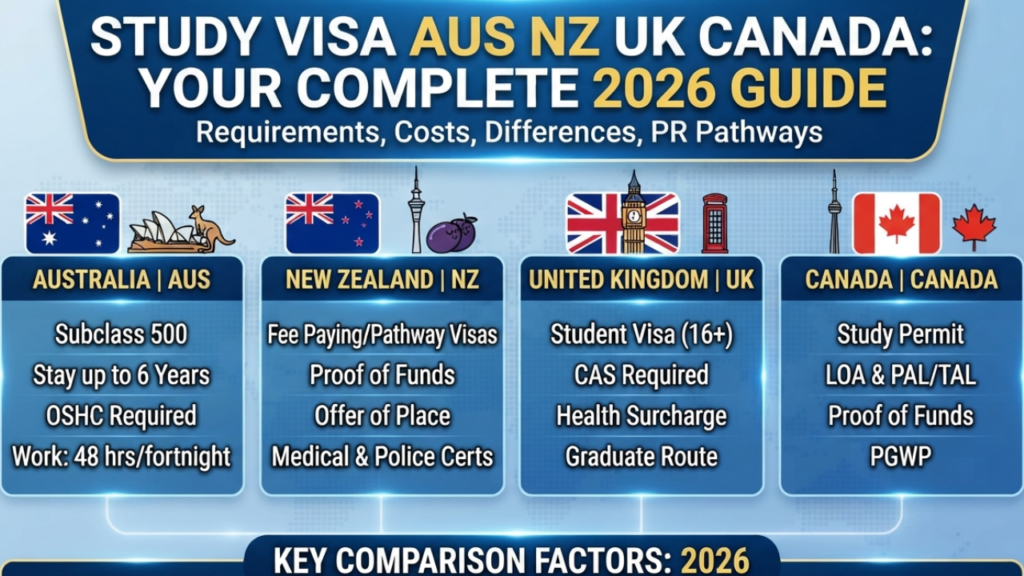
Choosing the right study destination abroad is one of the most critical decisions for international students. The options Study Visa Aus Nz Uk Canada (often abbreviated in searches as Study Visa Aus Nz Uk Canada) offer world-class education systems, vibrant multicultural societies, and structured post-graduation work opportunities. However, each country maintains distinct immigration frameworks, financial proof requirements, application rules, and policy updates for 2026.
This comprehensive guide breaks down everything you need to know about student visas across all four nations, featuring detailed comparative tables, document checklists, handling of study gaps, processing times, and frequently asked questions.
Also Read More: IELTS and PTE Coaching in Tricity: Choose the Right Training for Your Study Abroad Journey
1. Australia Student Visa (Subclass 500)
Overview & Stay Duration
The Australian Student Visa (Subclass 500) allows international students to participate in eligible courses of study in Australia. Your stay duration is generally aligned with your course length, up to 6 years, in line with your Confirmation of Enrolment (CoE).
Costs & Concessions
-
Base Application Fee: From AUD 2,500.00 (concessions apply in limited circumstances).
-
Cost Concessions: Lower visa costs apply to eligible Pacific Island and Timor-Leste citizens, eligible ASEAN citizens, and applicants in the ELICOS and Non-Award sectors who lodge a valid application.
Key Eligibility & Recent 2026 Rule Changes
-
Application Rule Updates: New rules implemented from 2 October 2026 modify who can apply for and be granted a visa while onshore in Australia, and whether family members can be included in a Student Visa application.
-
Core Requirements:
-
Must apply online.
-
Must apply from outside Australia unless holding an eligible visa and meeting an exemption.
-
Must hold a valid CoE when the visa is decided.
-
Must hold Overseas Student Health Cover (OSHC).
-
Must be 6 years or older.
-
Minors (under 18) must prove approved welfare arrangements.
-
Restrictions apply on bringing family members (partners/children) unless exempt.
-
Work Rights & Conditions
-
Students can work up to 48 hours a fortnight when their course of study or training is in session.
-
Strict adherence to attendance and academic progress conditions is mandatory.
Also Read More: Australia Immigration Updates 2026: Key Visa and Migration Changes Announced on 17 September
2. New Zealand Student Visas
Visa Options for Studying in New Zealand
New Zealand offers specialized visa categories depending on the duration and nature of your study program. If you want to study for more than 3 months, you require an Offer of Place from an approved education provider.
-
Fee Paying Student Visa: The most common option for international students. Allows full-time study for up to 4 years. Students pay the full cost of courses.
-
Dependent Child Student Visa: Allows holders of appropriate work or student visas to bring dependent children (19 and younger) to study as domestic students at primary or secondary schools.
-
English Language Student Visa: For full-time English language training at approved institutions.
-
Pathway Student Visa: Allows you to study up to 3 consecutive courses on a single visa plan.
Temporary Visas & Alternative Study Paths
-
Visitor Visa / NZeTA: Allows short-term study up to 3 months in any 12-month period.
-
Working Holiday Visas: Permits studying one or more courses for up to 6 months (study must be a secondary intention to holidaying).
-
Australian Citizens: Do not require a student visa to study in New Zealand.
Application Process & Timelines
-
Application Window: International students are strongly encouraged to apply at least 3 months before their intended travel date. Peak processing periods occur from November to March and June to August.
-
Key Supporting Steps: Secure an Offer of Place, complete online applications via RealMe, declare all assistance using form INZ 1226, and provide proof of funds.
3. United Kingdom Student Visa
Overview & Course Requirements
The UK Student Visa has replaced the older Tier 4 (General) system. You can apply if you are 16 or over and have been offered a place on a further or higher education course by a licensed student sponsor.
Core Criteria:
-
-
Valid Confirmation of Acceptance for Studies (CAS) reference number.
-
Sufficient funds to support tuition and monthly living costs.
-
Proficiency in English (speaking, reading, writing, listening).
-
Parental consent if aged 16 or 17.
-
Application Timelines & Fees
-
When to Apply (Outside UK): Up to 6 months before your course starts.
-
When to Apply (Inside UK): Up to 3 months before your course starts.
-
Decision Speed: Usually within 3 weeks from outside the UK, or 8 weeks from inside (fast-track options available for extra fees).
-
Visa Fees: Standard application fee is £850 (applicable from outside or inside the UK).
-
Healthcare Surcharge: Mandatory Immigration Health Surcharge (IHS) must be paid based on visa duration.A
Stay Duration & The Graduate Visa Route
-
Degree Level (18+): Usually up to 5 years.
-
Below Degree Level: Usually up to 2 years.
-
Graduate Route (Post-Study Work): Allows graduates to stay after successful completion:
-
2 years if applying on or before 31 December 2026.
-
18 months if applying on or after 1 January 2027.
-
3 years for PhD or doctoral graduates.
-
The UK Immigration Health Surcharge (IHS) is a mandatory fee paid as part of the UK visa application process to access most National Health Service (NHS) healthcare services during the eligible stay in the UK. At the standard IHS rate of £1,035 per year, the total IHS for a 3-year period is £3,105 (£1,035 × 3). Based on an approximate exchange rate of £1 = ₹127.40, this comes to approximately ₹3,95,577, or around ₹3.96 lakh in Indian currency. The applicable IHS amount is generally required to be paid upfront in one lump sum during the visa application process, rather than being paid separately each year. Therefore, for a 3-year period, an applicant paying the standard £1,035 annual rate should budget approximately £3,105 (₹3.96 lakh) for the IHS. The surcharge generally provides access to most NHS healthcare services, while certain expenses such as prescriptions, dental treatment and eye tests may need to be paid separately. The final amount charged can vary depending on the exact visa duration, applicable IHS rules and exchange rate at the time of payment.
4. Canada Study Permit
Eligibility & Designated Learning Institutions (DLIs)
To study in Canada, foreign nationals must obtain a Study Permit and be enrolled at a Designated Learning Institution (DLI).
Mandatory Documentation
-
Letter of Acceptance (LOA): Issued by your DLI and subject to school validation.
-
Provincial or Territorial Attestation Letter (PAL / TAL): Required in most cases (or a Quebec Acceptance Certificate [CAQ] if studying in Quebec).
-
Proof of Identity: Valid passport and 2 recent passport-size photos.
-
Proof of Funds: Evidence of sufficient funds to cover tuition, living expenses, and return transportation.
-
Letter of Explanation: Recommended to outline study goals and intent to leave post-completion.
-
Medical Exams & Police Certificates: Required depending on stay duration and country of origin.
Application Workflow & Arrival
-
Online Submission: Mandatory for most applicants unless disabled or holding non-national travel documents. Doctoral (PhD) applicants benefit from streamlined, faster processing.
-
Port of Entry: Successful applicants receive a Port of Entry letter of introduction to present to border services officers upon arrival, along with valid eTA or temporary resident visas.
Comprehensive Country Comparison Tables
High-Level Overview (Costs, Timings, and Stay Durations)
Work Rights & Post-Study Work / PR Pathways
| Country | Work Rights During Studies | Post-Study Work Visa (PSW) / Work Opportunities | PR Pathways Accessibility |
|---|---|---|---|
| 🇦🇺 Australia | Up to 48 hours per nightly during study periods | Temporary Graduate Visa (Subclass 485) | Moderate to High via skilled migration points and State/Federal pathways |
| 🇳🇿 New Zealand | Dependent on visa conditions; usually up to 20 hours/week | Post-study work opportunities for eligible graduates, including bachelor’s degrees and skill-shortage areas | Structured pathways through Green List and Skilled Migrant Category |
| 🇬🇧 United Kingdom | Limited work permissions depending on term-time and vacation periods | Graduate Visa — 2 years standard; changes apply from January 2027 | Transition to Skilled Worker Visa generally required; direct PR pathway is more complex |
| 🇨🇦 Canada | Off-campus work permitted subject to study-permit eligibility and applicable rules | Post-Graduation Work Permit (PGWP) for eligible graduates | Express Entry (CEC) and Provincial Nominee Programs (PNPs) |
Required Documents Breakdown
| Document Type | 🇦🇺 Australia | 🇳🇿 New Zealand | 🇬🇧 United Kingdom | 🇨🇦 Canada |
|---|---|---|---|---|
| Admission Proof | Confirmation of Enrolment (CoE) | Offer of Place | CAS Number | LOA + PAL/TAL |
| Financial Proof | Required – living costs, tuition fees & airfare | Sufficient funds evidence | Proof of funds for tuition & living expenses | Proof of funds + GIC/bank records, where applicable |
| Language Test | IELTS / PTE / TOEFL | Required depending on programme | Secure English Language Test (SELT), where required | IELTS / other accepted test, as required by DLI/visa requirements |
| Health / Medical Requirements | OSHC + Biometrics; medical examination may be required | Medical & X-ray (depending on stay/requirements); Police certificate where applicable | Healthcare Surcharge (IHS); TB test where applicable | Medical exam + Police certificate, where required |
| TB Test | May be required depending on circumstances | May be required depending on circumstances | Required for applicants from certain countries | May be required depending on circumstances |
| Police Certificate | May be required | May be required, particularly for longer stays | May be requested depending on circumstances | May be required depending on circumstances |
Addressing Common Challenges: Study Gaps, Timings, and Ease of Access
How to Handle Study Gaps Across Study Visa Aus Nz Uk Canada
Study gaps (time elapsed between your last qualification and your intended start date) are closely scrutinized by visa officers to evaluate genuine intent:
-
Australia: Requires robust justification under the Genuine Student (GS) requirement. Employment experience or continuous professional development during the gap must be documented.
-
New Zealand: Gaps must be justified logically via a Statement of Purpose, proving that further education aligns with career progression.
-
United Kingdom: Highly dependent on the sponsor university. If a licensed student sponsor issues a CAS, visa officers focus heavily on academic progression and English proficiency.
-
Canada: Handled primarily through a detailed Letter of Explanation. Explaining work history, promotions, or personal circumstances during the gap is vital to satisfy officers that study is a logical career upgrade.
Processing Timings and Peak Periods
-
Australia: Subject to strict Ministerial Directions (e.g., MD 115). Applications submitted before peak periods face fewer bottlenecks.
-
New Zealand: Peak volumes occur November to March and June to August. Applying at least 3 months ahead is mandatory.
-
UK: Standard timelines are predictable (3 weeks offshore), but expedited premium services can be purchased.
-
Canada: Varies significantly by country of application. Biometrics collection should be completed immediately after submission to avoid delays.
Which Country is Easier to Get? (Comparative Ease Analysis)
-
Easiest Admission Process: UK universities often have streamlined admissions if language proficiency and financial thresholds are met.
-
Strictest Policy Controls: Australia has introduced tighter caps, higher visa fees (AUD 2,500+), and rigorous integrity checks (GS requirement). Canada has implemented stringent regional caps with Provincial Attestation Letters (PALs).
-
Balanced Regional Options: New Zealand offers a transparent, straightforward application framework via RealMe for applicants meeting clear funding and offer criteria.
Frequently Asked Questions (FAQs)
H4: Can I bring my family or spouse with me on a student visa?
-
Australia: Recent 2026 updates restrict bringing family members unless specific exemptions apply.
-
New Zealand: Eligible student visa holders can support partner work visas and dependent child student visas.
-
UK: Dependants (‘partners and children’) are permitted under strict eligibility rules tied to postgraduate or sponsored research levels.
-
Canada: Spouses of eligible students may qualify for open work permits under specific program guidelines.
H4: What are the English language test requirements?
All four countries require recognized proof of English language proficiency—typically IELTS, PTE Academic, or TOEFL iBT—unless you are a citizen of an exempt English-speaking country or your previous education was fully conducted in English.
H4: Can I change my course or institution after arriving?
-
Australia: Changing courses requires a new CoE and adherence to visa conditions.
-
New Zealand: Varies by visa type; substantial changes require notifying Immigration New Zealand.
-
UK: Changing your sponsor requires a new CAS and fresh visa application under strict compliance rules.
-
Canada: Post-secondary students changing Designated Learning Institutions (DLIs) must follow official IRCC notification protocols through their online account.
Conclusion
Navigating the application process for a Study Visa Aus Nz Uk Canada requires careful planning, timely document gathering, and strict adherence to changing 2026 immigration policies. Whether you prioritize Australia’s robust climate and work rights, New Zealand’s scenic academic environment, the UK’s accelerated degree structures, or Canada’s structured post-graduation pathways, understanding these financial, operational, and documentation nuances ensures a successful study abroad journey.