
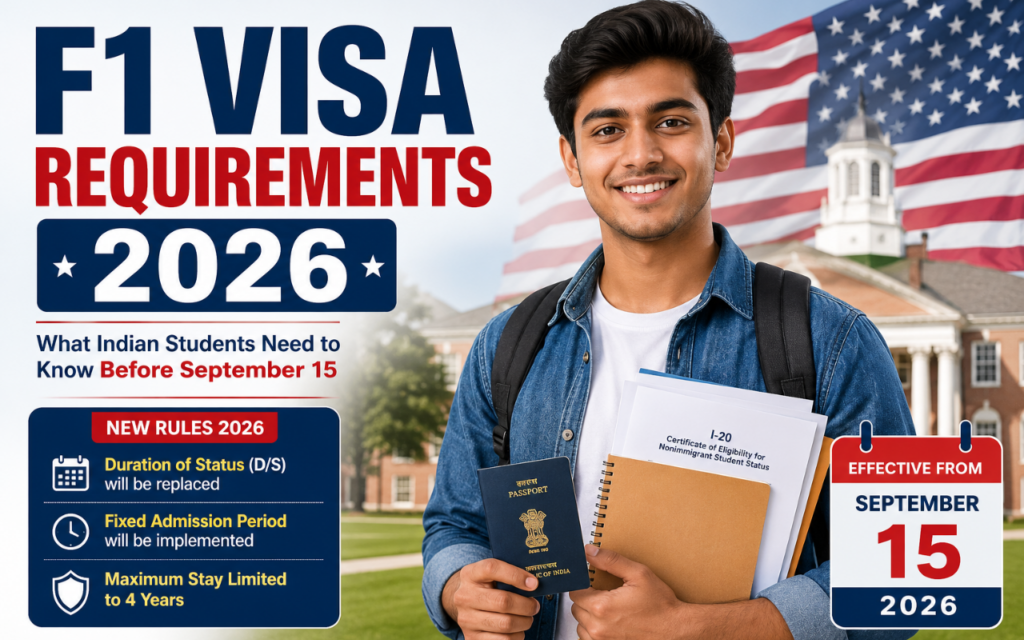
Planning to study in the United States in 2026? Understanding the F-1 visa requirements is an important step before applying for a U.S. student visa. Students need to meet academic, financial, and documentation requirements and complete the visa application and interview process. For Indian students, 2026 is also an important year because new rules affecting the admission period for international students are scheduled to take effect on September 15, 2026. The new framework changes the traditional Duration of Status system and introduces a fixed period of admission.
This guide explains the F1 visa requirements, required documents, financial proof, application process, interview preparation, fees, and the latest 2026 changes.
What Are the Requirements for an F1 Student Visa?
An F-1 student visa is generally used by international students who want to pursue academic studies at an eligible educational institution in the United States.
Before applying, students generally need to:
- Be accepted by an eligible U.S. educational institution
- Receive a Form I-20
- Complete the required SEVIS process
- Complete the DS-160 application
- Pay the applicable visa and SEVIS fees
- Demonstrate the ability to fund their education and living expenses
- Provide appropriate academic and supporting documents
- Attend the required visa interview
- Provide truthful and consistent information throughout the application
The exact documents and circumstances can vary from one applicant to another.
Who Is Eligible for an F1 Student Visa?
Students should understand the eligibility criteria for an F1 student visa before beginning the application process.
Important factors generally include:
- Admission to a qualifying U.S. institution
- Appropriate academic qualifications
- A genuine purpose of studying in the United States
- Sufficient financial resources
- A clear understanding of the selected course and institution
- Compliance with applicable U.S. immigration requirements
Your academic history, selected course, university, financial background, and overall circumstances should make sense together.
There is no single academic profile or financial amount that guarantees visa approval.
Documents Needed for F1 Student Visa Application
Preparing the correct documents is one of the most important parts of the application.
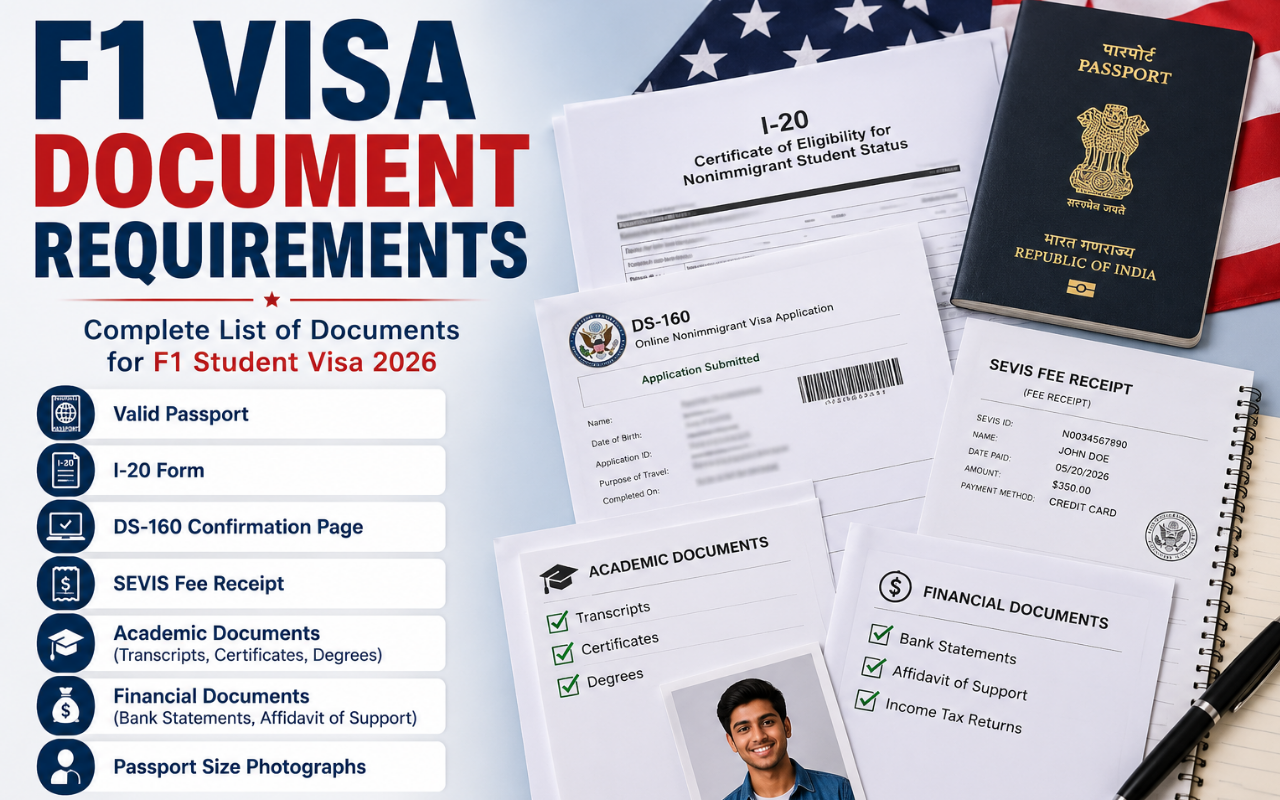
Common documents include:
| Document | Purpose |
|---|---|
| Valid Passport | Identity and international travel |
| Form I-20 | Confirms your student and program information |
| DS-160 Confirmation | Proof of completed online application |
| SEVIS Fee Receipt | Proof of required SEVIS payment |
| Appointment Confirmation | Details of your visa appointment |
| Admission Letter | Proof of university admission |
| Academic Certificates | Education history |
| Academic Transcripts | Academic performance |
| Financial Documents | Proof of available funds |
| Sponsor Documents | If someone else is funding your education |
| Loan Documents | If education is financed through a loan |
| Scholarship Documents | If applicable |
Students should organize their original documents and supporting evidence before attending the interview.
Financial Proof Required for F1 Student Visa
Financial preparation is an important part of the application.
Students may need to demonstrate that they have sufficient funds to cover their expected educational and living expenses.
Financial evidence can include:
- Bank statements
- Fixed deposits or other acceptable financial assets
- Education loan documents
- Scholarship letters
- Sponsor’s income documents
- Sponsor’s bank statements
- Proof of tuition payments
- Other legitimate sources of funding
How much money is required for an F-1 student visa?
There is no single universal bank-balance requirement for every student.
The amount a student needs depends on factors such as:
- University tuition
- Course duration
- Location
- Estimated living expenses
- Scholarships
- Education loans
- Financial sponsorship
Students should ideally demonstrate that their available funding is consistent with the costs shown by their institution and financial documents.
Avoid relying on websites that claim that every applicant needs a specific fixed bank balance.
How to Apply for F1 Student Visa from India
The application process can be completed through several important stages.
Step 1: Choose a University
Research U.S. universities and programs according to your academic background, career goals and budget.
Step 2: Apply for Admission
Submit the required academic and financial documents to your selected institution.
Step 3: Receive Form I-20
After admission and completion of the institution’s requirements, eligible students receive Form I-20.
Step 4: Complete the SEVIS Process
Pay the applicable SEVIS I-901 fee and retain the payment receipt.
Step 5: Complete DS-160
Fill out the online nonimmigrant visa application and keep your confirmation page.
Step 6: Pay the Visa Fee
The U.S. Department of State currently lists the F-category student visa application processing fee at $185.
Step 7: Schedule Your Appointment
Follow the current instructions for scheduling the required visa appointment in India.
Step 8: Prepare for the Interview
Review your academic documents, financial information, university details and study plans.
Step 9: Attend the Interview
Answer questions honestly and consistently.
Step 10: Receive the Decision
After the interview and any required administrative processing, the application may be approved, refused or require additional processing.
What Are the New F1 Student Visa Rules in 2026?
One of the biggest developments for international students in 2026 is the DHS final rule changing the admission framework for F and J nonimmigrants.
The final rule was published on July 17, 2026, with a scheduled effective date of September 15, 2026. It replaces the traditional Duration of Status (D/S) framework with a fixed period of admission.
Under the new framework, students will generally be admitted for a fixed period based on their program, subject to a maximum of four years. Students who need additional time may need to follow the applicable extension process.
What Is the New Four-Year Rule?
The four-year provision should not be interpreted as meaning that every student can study in the United States for only four years.
Instead, the new framework generally establishes a fixed admission period that cannot exceed four years. Students who require additional time because of their program or circumstances may need an extension.
This distinction is important for students planning longer programs or students who experience academic delays.
What Changes for F1 Students From September 15, 2026?
The new rule is scheduled to become effective on September 15, 2026
The major change is the move from Duration of Status toward a fixed admission period.
| Area | Previous Framework | New Framework |
|---|---|---|
| Admission | Duration of Status | Fixed admission period |
| Admission End | Based on maintaining status/program requirements | Fixed admission end date |
| Maximum Fixed Period | D/S framework | Generally up to 4 years |
| Additional Time | Existing D/S procedures | Extension may be required |
| Effective Date | Existing system | September 15, 2026 |
Students should check their individual admission record, Form I-20, I-94 and university guidance because implementation can depend on the student’s circumstances.
How New F1 Rules Affect Indian Students in 2026
The changes may have both benefits and challenges for Indian students.
| Area | Potential Benefit | Potential Challenge |
|---|---|---|
| Study Planning | Clearer admission timeline | Students must monitor the end date |
| Program Duration | More predictable planning | Delays may require additional action |
| Immigration Compliance | Defined admission period | Greater responsibility to track status |
| Longer Programs | Clearer planning | Extension procedures may become important |
| Travel | Clearer admission information | Students need to check current status before travel |
For students who complete their program within the authorized period, the new system may provide a clearer timeline.
However, students who need additional time because of academic delays, program changes or other circumstances should understand the applicable extension procedures.
How Much Does It Cost to Apply for an F1 Student Visa?
The cost includes government fees as well as university and living expenses.
| Expense | Cost / Information |
|---|---|
| Student Visa Application Fee | $185 |
| SEVIS I-901 Fee | Verify current official amount before publishing |
| Tuition | Varies by university and program |
| Living Expenses | Varies by location |
| Health Insurance | Depends on institution |
| Travel Expenses | Depends on itinerary |
The visa application fee and SEVIS fee are separate charges. Students should verify the latest government fees before making payment because fees can change.
Why Is an F1 Student Visa Rejected?
There is no single reason for refusal, but common problems can include:
- Incomplete documentation
- Inconsistent information
- Unclear study plans
- Weak explanation of course selection
- Unclear source of funding
- Poor interview preparation
- Inability to explain the chosen university
- Inaccurate or misleading information
- Failure to satisfy applicable visa requirements
Students should focus on providing genuine information rather than trying to memorize answers.
Conclusion
Understanding the F1 Visa Requirements is essential for Indian students planning to study in the United States in 2026. Students should prepare their academic documents, financial evidence, Form I-20, SEVIS information, DS-160 and interview preparation carefully.
The September 15, 2026 rule change is another important development. The new framework moves away from Duration of Status toward a fixed admission period, generally subject to a four-year maximum, with additional procedures potentially required when students need more time.
Before applying or travelling, students should always check the latest information from official U.S. government sources and their university’s international student office.
Frequently Asked Questions
What are the F1 Visa Requirements in 2026?
Students generally need admission to a qualifying U.S. institution, Form I-20, SEVIS registration/payment where applicable, DS-160, required fees, financial evidence and supporting documents.
What documents are needed for an F1 Student Visa?
Common documents include a passport, Form I-20, DS-160 confirmation, SEVIS fee receipt, appointment confirmation, academic records and financial documents.
How much money is required for an F1 Student Visa?
There is no single universal amount. Students should demonstrate sufficient funding based on their tuition, living expenses and other expected costs.
What changes on September 15, 2026?
The new DHS rule is scheduled to replace the traditional Duration of Status framework with a fixed period of admission.
Does the four-year rule mean students can study only four years?
No. The four-year provision concerns the maximum fixed admission period under the new framework. It is not a blanket lifetime limit on F-1 education.
How will the new rules affect Indian students?
The practical effect depends on the student’s program, admission period, status and individual circumstances. Students should monitor their authorized admission period and understand any extension requirements.