
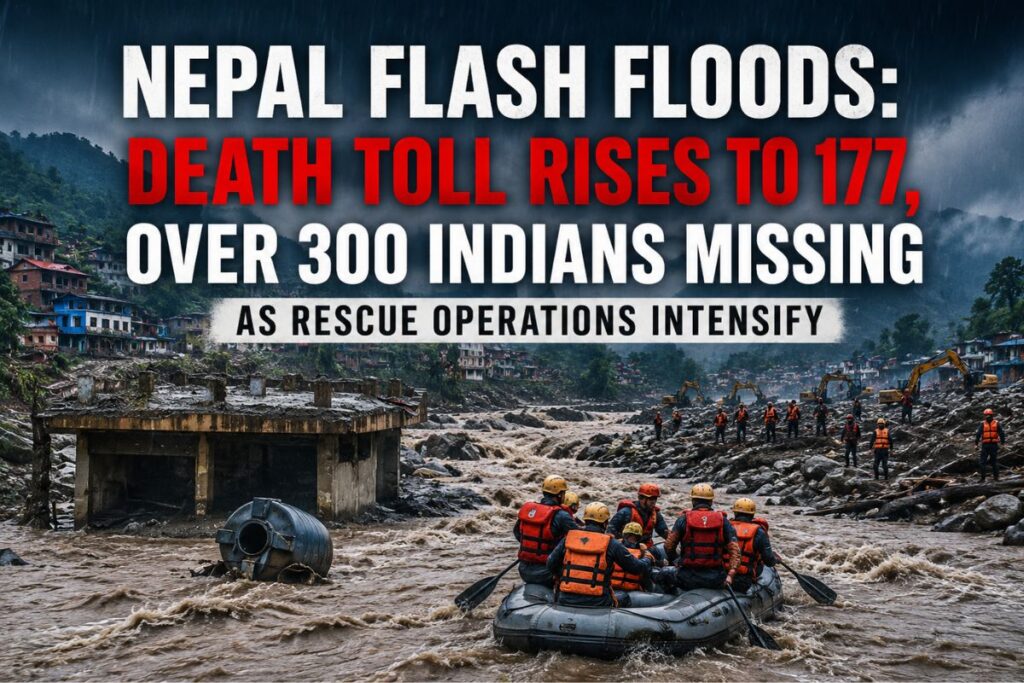
A devastating flash flood along the Nepal-Tibet border has triggered a major humanitarian crisis, with the death toll rising sharply and hundreds of people still unaccounted for. According to the latest reports, 177 bodies have been recovered in Nepal, while hundreds of people remain missing as rescue teams continue searching affected areas. The disaster has also raised serious concerns over the safety of Indian nationals, with Nepalese authorities reporting that more than 300 Indians are among those missing.
The flash floods struck on August 26 after a sudden surge of water and debris swept through parts of Nepal’s Rasuwa district and surrounding areas near the border with Tibet. The Bhotekoshi River system was severely affected, and downstream areas were also devastated. Entire settlements, roads, bridges and other infrastructure were damaged or washed away, making rescue operations extremely difficult.
Hundreds Still Missing
The number of missing people has continued to change as authorities receive information from different affected districts. Nepal’s disaster management authorities have reported hundreds of people unaccounted for, including residents, security personnel and tourists. The latest figures from the Nepal Tourism Board indicate that 590 tourists were reported out of contact, including 476 foreign nationals and 114 Nepali citizens. Among the foreign tourists, Indians reportedly form the largest group, with 177 Indian nationals listed as missing by the tourism authorities.
Nepal’s Foreign Minister Shisir Khanal has separately said that nearly 300 Indian nationals, many of them believed to be travelling for the Kailash Mansarovar pilgrimage, were among thousands reported missing. Because information from the affected mountainous region is still being collected, the numbers may continue to change as rescue agencies establish contact with people who were stranded or displaced.
Kailash Mansarovar Pilgrims Among Those Missing
A major concern has been the safety of pilgrims and tourists travelling through the region on their way towards Tibet and Mount Kailash. Several groups of Indian pilgrims were reportedly in the affected area when the disaster struck.
Earlier reports said that a group of 77 people associated with the Isha Foundation were at an immigration facility in the Gyirong area when the disaster occurred. Other Indian pilgrims from Tamil Nadu and West Bengal were also reported to be unaccounted for.
The destruction of roads and border infrastructure has made communication and movement particularly challenging. Rescue teams are therefore relying heavily on helicopters and other emergency resources to reach isolated locations.
What Caused the Disaster?
Initial reports created uncertainty about whether an earthquake or another geological event had triggered the sudden flooding. Later assessments pointed towards a glacial collapse and debris flow in the Himalayan region. The resulting surge of water and debris moved rapidly through river valleys, causing extensive destruction within a very short period.
The disaster highlights the vulnerability of Himalayan communities to sudden glacier-related events. Experts have also warned that changing climatic conditions and the rapid melting and destabilisation of glaciers can increase risks in mountainous regions.
India Steps Up Relief and Rescue Assistance
India has intensified its humanitarian response following the disaster. Prime Minister Narendra Modi spoke with Nepal’s Prime Minister Balendra Shah and conveyed condolences over the loss of lives while assuring Nepal of India’s support.
India initially sent around 10 tonnes of humanitarian assistance and essential medicines to Nepal through an Indian Air Force aircraft. The supplies included emergency materials such as temporary shelters, blankets, hygiene kits, solar lamps, and medicines.
On August 27, India sent a second consignment carrying 37.5 tonnes of humanitarian assistance and disaster-relief material, medicines and food packets. External Affairs Minister S. Jaishankar said India remained in close contact with Nepalese authorities and would continue supporting relief operations.
The Indian Embassy in Kathmandu has also been coordinating with Nepalese authorities regarding the safety and rescue of Indian nationals. Emergency contact numbers have been issued for families seeking information about people affected by the floods.
Rescue Operations Continue
Nepal has deployed security personnel and rescue teams to search riverbanks, downstream areas and locations covered by mud and debris. Helicopters are being used to evacuate stranded people and transport emergency supplies where roads have been destroyed.
However, difficult terrain, damaged infrastructure, heavy mud and continuing weather-related risks are slowing the operation. Authorities are also monitoring the possibility of additional flooding in vulnerable areas.
As rescue teams continue their search, families across Nepal, India and other countries are waiting for information about missing relatives. With the death toll already reaching 177 in Nepal and hundreds still unaccounted for, the priority remains locating survivors, providing emergency medical assistance, and reaching communities cut off by the disaster.
Note: The figures are developing rapidly and may change as Nepalese authorities update their official casualty and missing-person records.