
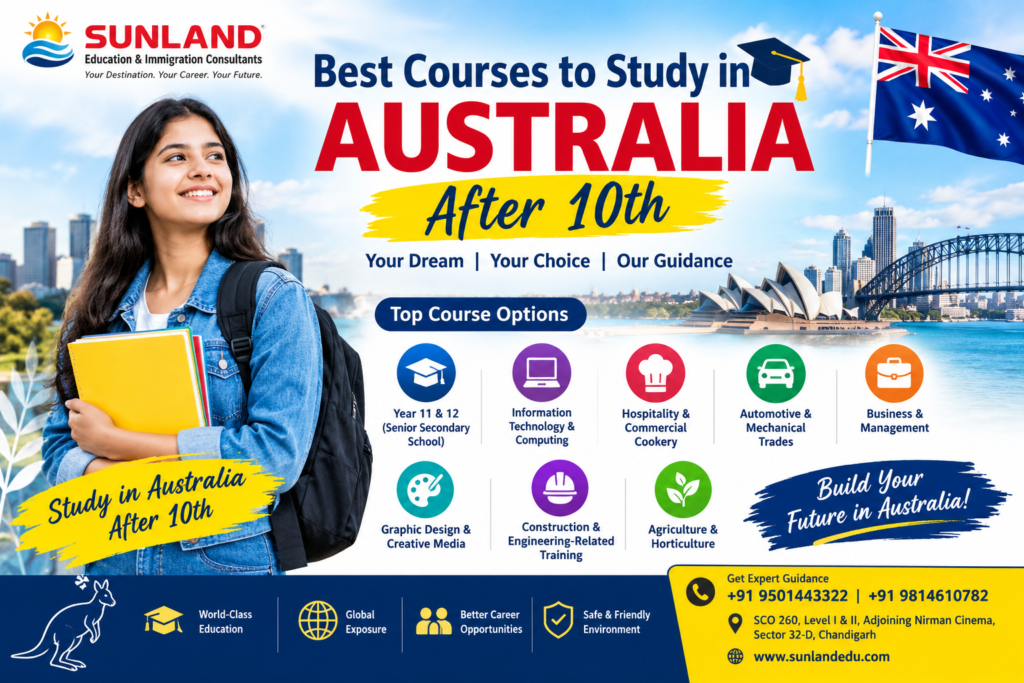
Choosing the right educational pathway after completing Class 10 is an important decision for students who want to build an international academic career. Australia is a popular destination for international education, offering secondary school qualifications, vocational training, and pathways to university. However, the most suitable option depends on the student’s age, academic performance, career interests, English proficiency, and long-term goals.
For Indian students exploring the Best Courses to Study in Australia After 10th, it is important to understand that not every diploma or certificate course accepts students directly after Class 10. Some vocational qualifications require Year 10 or its recognised equivalent, while many diploma and advanced diploma programs require Year 12 or equivalent. Requirements vary by institution and course.
1. Can Indian Students Study in Australia After 10th?
Yes, Indian students may be able to study in Australia after Class 10, depending on their age, academic qualifications, the institution’s admission policy, and the selected program.
The Australian education system includes secondary school education through Year 10, followed by senior secondary education in Years 11 and 12. Students who plan to pursue a university degree commonly complete senior secondary education before applying for undergraduate admission.
Also Read More:
Study Australia+1
After Class 10, students can explore these main pathways:
-
Senior secondary school: Enrol in an appropriate Year 11 program and continue to Year 12.
-
Vocational Education and Training (VET): Explore eligible certificate-level courses offering practical, industry-focused training.
-
English language preparation: Consider an English language course if it is appropriate for the student’s educational plan and visa circumstances.
-
Long-term university pathway: Complete the required school or pathway qualifications before progressing to a bachelor’s degree.
Students should confirm admission eligibility directly with their chosen institution before making financial or travel arrangements.
2. Best Courses to Study in Australia After 10th
The following are useful study areas to research. They are not a guarantee of direct admission after Class 10; the exact qualification level and entry criteria must be checked for each provider.
A. Year 11 and Year 12 (Senior Secondary School)
For students who want to attend university in the future, completing senior secondary education is often the most straightforward academic route.
Students can choose subjects based on their interests and intended degree, subject to the school’s curriculum and availability.
Possible subject areas include:
-
Mathematics and sciences
-
Business and economics
-
Humanities and social sciences
-
Information technology
-
Creative arts and design
Who should consider this option? Students who want to keep their university choices open, including future studies in engineering, business, IT, health sciences, or other academic fields.
Completing Year 11 and Year 12 can lead to an Australian senior secondary qualification that is used for university applications.
Study Australia+1
B. Information Technology and Computing
Information technology is an area worth exploring for students who enjoy computers, digital systems, and problem-solving.
Depending on their eligibility, students may research introductory computing or IT qualifications that cover topics such as:
-
Computer fundamentals
-
Basic networking
-
Programming concepts
-
Digital technology
-
Cybersecurity fundamentals
Some advanced IT programs may require prior study or a higher school qualification. Students should compare entry requirements and course content before selecting a program.
C. Hospitality and Commercial Cookery
Hospitality and cookery programs can suit students interested in food preparation, culinary techniques, restaurants, hotels, and tourism.
Relevant study areas may include:
-
Food preparation
-
Kitchen operations
-
Commercial cookery
-
Hospitality services
-
Customer service
Entry-level and advanced qualifications have different requirements. Before applying, students should check whether a specific course accepts their Class 10 qualification and whether it is available to international students.
D. Automotive Technology and Mechanical Trades
Students who prefer practical and technical learning may investigate automotive or mechanical training.
Possible subject areas include vehicle servicing, automotive workshop practices, mechanical systems, and technical maintenance.
These programs can involve practical assessments and workshop training. Students should review safety requirements, course prerequisites, and the qualification level before applying.
E. Business and Management
Business is another field that students may consider when planning a future career in administration, entrepreneurship, accounting, or management.
Topics can include:
-
Business communication
-
Introduction to management
-
Business operations
-
Customer relations
-
Entrepreneurship fundamentals
Many diploma-level business courses require Year 12 or equivalent, so students who have only completed Class 10 should verify eligibility carefully.
TAFE Queensland+1
F. Graphic Design and Creative Media
Students interested in art, visual communication, photography, or digital content may explore creative media and design programs.
Potential learning areas include graphic design principles, image editing, digital illustration, multimedia production, and visual communication.
The required portfolio, software knowledge, and academic background vary by course and institution.
G. Construction and Engineering-Related Training
Students interested in buildings, infrastructure, technical drawing, or practical engineering skills can explore suitable construction and engineering-related education pathways.
Depending on the qualification, course content may include construction fundamentals, technical drawing, building technology, or introductory engineering concepts.
Professional engineering degrees generally require further academic preparation, including the relevant senior secondary qualifications and prerequisite subjects. An introductory certificate should not be confused with a university engineering degree.
H. Agriculture and Horticulture
Agriculture and horticulture may be suitable for students interested in plants, farming systems, landscaping, environmental practices, or agricultural technology.
Possible study areas include plant care, horticultural practices, soil fundamentals, landscaping, and agricultural operations.
The availability of international enrolment and entry after Class 10 must be confirmed for the specific program.
Australia’s vocational education system includes fields such as IT, hospitality, automotive, construction, agriculture, and creative industries.
Study Australia+1
3. Diploma Courses in Australia After 10th
Many Indian students search for Diploma Courses in Australia After 10th because they want practical education and a structured career pathway. However, students should understand the difference between a certificate, diploma, and advanced diploma.
Australian vocational qualifications are part of the Australian Qualifications Framework (AQF), which establishes different levels of education and training.

Study Australia+1
| Qualification | General purpose | Important consideration |
|---|---|---|
| Certificate I–II | Introductory skills and training | Entry requirements vary |
| Certificate III | Technical or occupational skills | Some providers accept Year 10 equivalent |
| Certificate IV | More advanced vocational learning | Often requires additional preparation |
| Diploma | Specialised and professional-level skills | Many courses require Year 12 |
| Advanced Diploma | Advanced technical or specialised study | Check academic prerequisites |
For example, TAFE Queensland states that its Certificate III courses generally require an Australian Year 10 qualification or equivalent, while Certificate IV, diploma, and advanced diploma courses generally require Year 12 or equivalent. Other providers may have different requirements.
TAFE Queensland+1
Therefore, students should not assume that completing Class 10 automatically qualifies them for a diploma.
4. Australia Student Visa After 10th: Eligibility Requirements
Students planning to study in Australia must consider both admission requirements and visa requirements. Getting admission to an institution does not automatically guarantee a student visa.
The following points are important when exploring an Australia Study Visa After 10th.
Academic qualifications
Students must meet the selected school’s or college’s academic entry requirements. Depending on the course, this may mean providing Class 10 marksheets, school certificates, or additional qualifications.
English language proficiency
Some institutions require evidence of English language proficiency. The required level depends on the course and provider. An English language preparation program may be an option for eligible students.
Study Australia+1
Confirmation of Enrolment
Students generally need a Confirmation of Enrolment (CoE) for their intended course when applying for an Australian Student visa, subject to the applicable visa rules.
Financial capacity
Applicants need to meet the applicable financial requirements for tuition fees, living expenses, travel, and other relevant costs.
Genuine Student requirement
Applicants must satisfy the applicable Genuine Student requirement and provide truthful, consistent information about their educational plans and circumstances.
Health, character, and welfare arrangements
Applicants must meet the relevant health and character requirements. For students under 18, appropriate accommodation, support, and welfare arrangements are also important.
Students should review the latest requirements on the official Australian Student visa (subclass 500) page before applying.
5. Australia School Admission After 10th: How to Apply
Students considering Australia School Admission After 10th can follow these steps.
-
Assess your academic background. Collect your Class 10 marksheets, school certificate, passport, and other relevant documents.
-
Choose your educational pathway. Decide whether Year 11–12 or an eligible vocational qualification best matches your future goals.
-
Research institutions. Compare course content, entry requirements, fees, location, and student support services.
-
Check international student registration. Verify that the institution and intended course are registered for international students where required.
-
Prepare your application. Submit the requested academic records, English-language evidence, and other documents.
-
Review your offer. Read the conditions, fees, refund policy, and enrolment requirements carefully.
-
Prepare your visa application. Follow the current Australian immigration rules and arrange any required welfare support if the student is under 18.
Students can use the official CRICOS register to check courses and institutions available to international students.
6. How to Choose the Right Course After Class 10
The right course depends on more than popularity. Students should consider their academic strengths, interests, budget, and future educational plans.
| Student’s goal | Pathway worth considering |
|---|---|
| Study at an Australian university | Year 11–12, followed by the required university pathway |
| Develop practical IT skills | Eligible introductory computing or IT qualification |
| Learn cooking and hospitality | Suitable entry-level hospitality or cookery training |
| Learn automotive skills | Eligible automotive or mechanical training |
| Explore business studies | Senior secondary education, followed by an eligible business program |
| Pursue creative work | Relevant school subjects and suitable design or media training |
These are general recommendations, not confirmed course offers. Always check the specific provider’s entry requirements before choosing a course.
7. Common Mistakes to Avoid
Students and parents should avoid these common mistakes when planning to study in Australia after Class 10.
-
Assuming every Australian college accepts Class 10 students.
-
Applying for a diploma without checking whether Year 12 is required.
-
Choosing a course only because someone claims it guarantees employment or permanent residency.
-
Ignoring tuition fees, living expenses, insurance, and other costs.
-
Enrolling in a course without checking its international student registration.
-
Treating admission as a guarantee of visa approval.
-
Overlooking accommodation and welfare requirements for students under 18.
Careful research and a realistic study plan can help students make better-informed decisions.
8. Frequently Asked Questions (FAQs)
1. Can I study in Australia after completing Class 10 in India?
Yes, eligible students may apply for suitable school or vocational pathways. Admission depends on age, academic qualifications, the course, and the institution’s requirements.
2. What are the best courses to study in Australia after 10th?
Year 11–12 is an important option for students planning to attend university. Other possible fields to explore include IT, hospitality, automotive, business, design, and agriculture, subject to course-specific eligibility.
3. Can I get a diploma in Australia after 10th?
Some students may find eligible vocational pathways, but many diploma courses require Year 12 or equivalent. Always confirm the entry criteria with the provider.
4. Is IELTS compulsory for studying in Australia after 10th?
Not necessarily in every case. English-language requirements vary by institution, course, and visa circumstances. Students should check the applicable requirements before applying.
5. Can students under 18 apply for an Australian Student visa?
Eligible students under 18 may apply, but additional accommodation, support, and welfare arrangements may be required. Admission and visa approval are assessed under the relevant rules.
6. How can I find recognised courses in Australia?
Use the official CRICOS register to search for institutions and courses available to international students. You should also check the provider’s academic entry requirements and fees.
Conclusion
Choosing the Best Courses to Study in Australia After 10th starts with understanding the student’s educational background and long-term goals. For many students who want to pursue a bachelor’s degree, completing Year 11 and Year 12 is a sensible pathway. Students interested in practical training can also explore suitable vocational qualifications, provided they meet the course’s entry requirements.