
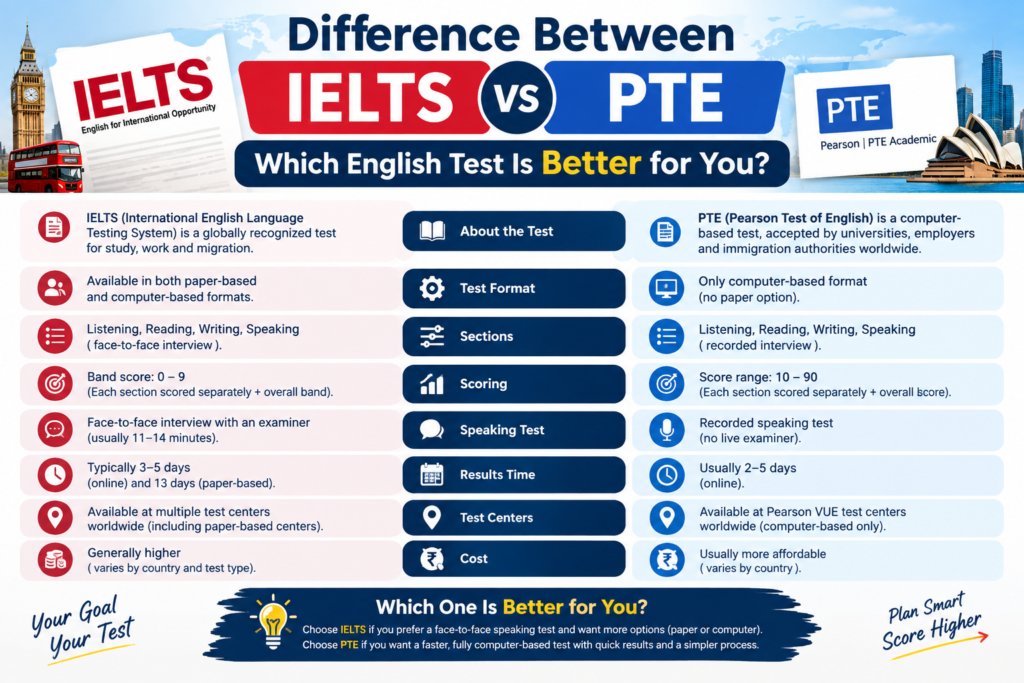
IELTS and PTE are two of the most popular English language proficiency tests taken by students and professionals who want to study, work or migrate abroad. Both tests assess your English language skills, but their exam format, scoring system, question types, speaking test and result processing are different.
Choosing between IELTS and PTE depends on your English skills, preferred exam format, target country, university requirements and how comfortable you are with computer-based testing.
In this guide, we will explain the difference between IELTS and PTE in simple terms and compare the two exams based on important factors such as exam pattern, duration, scoring, difficulty and results.
Also Read More: Best IELTS PTE Institute in Chandigarh: Master English Proficiency
IELTS vs PTE: Quick Comparison
| Feature | IELTS | PTE |
|---|---|---|
| Full Form | International English Language Testing System | Pearson Test of English |
| Exam Mode | Paper or Computer | Computer-based |
| Skills Tested | Listening, Reading, Writing, Speaking | Listening, Reading, Writing, Speaking |
| Speaking Test | Usually with a human examiner | Computer-based |
| Test Duration | Around 2 hours 45 minutes | Around 2 hours |
| Scoring | Band score 0–9 | Score 10–90 |
| Result Time | Varies by test format | Usually faster |
| Question Format | Traditional language-test format | Computer-based integrated tasks |
| Best For | Students comfortable with human speaking tests | Students comfortable with computers and integrated tasks |
What Is IELTS?
IELTS, or International English Language Testing System, is one of the world’s most widely recognised English proficiency tests.
IELTS evaluates four major English skills:
- Listening
- Reading
- Writing
- Speaking
There are different versions of IELTS depending on the candidate’s purpose, including IELTS Academic and IELTS General Training.
For students applying to universities and colleges abroad, IELTS Academic is commonly required. The test uses a 0 to 9 band scoring system, and candidates receive individual scores for each section along with an overall band score.
One major difference is the IELTS Speaking test. It is generally conducted as a separate interview with a trained examiner, which means candidates need to communicate directly with a person.
Also Read More: STUDY VISA CONSULTANT IN CHANDIGARH
What Is PTE?
PTE, or Pearson Test of English, is a computer-based English language proficiency test. It assesses speaking, writing, reading and listening skills through computer-based tasks.
Unlike IELTS, the PTE Speaking section is completed using a computer and microphone rather than through a face-to-face interview with an examiner.
PTE uses a 10–90 scoring scale. The exam also includes integrated questions where one task may assess more than one English skill.
For students who are comfortable using computers, speaking into a microphone and working under timed conditions, PTE can be an attractive alternative to IELTS.
IELTS vs PTE Exam Pattern
The exam pattern is one of the most important differences between IELTS and PTE.
| Section | IELTS | PTE |
|---|---|---|
| Listening | Yes | Yes |
| Reading | Yes | Yes |
| Writing | Yes | Yes |
| Speaking | Human examiner | Computer/microphone |
| Question Types | Multiple formats | Multiple computer-based formats |
| Integrated Skills | Limited | More prominent |
| Test Environment | Computer or paper, depending on test | Computer-based |
IELTS generally follows a more traditional structure, while PTE relies heavily on computer-based tasks.
This means your choice should depend not only on your English level but also on how comfortable you are with the examination format.
Which Is Easier: IELTS or PTE?
There is no universal answer to whether IELTS or PTE is easier.
Some students find IELTS easier because they prefer communicating with a real examiner during the Speaking test. Others find PTE easier because the entire examination is computer-based and the speaking responses are recorded.
Your strengths can make a major difference.
For example, if you are good at speaking naturally with another person but find it difficult to speak into a microphone, IELTS may feel more comfortable.
On the other hand, if you prefer computers, quick responses and structured tasks, PTE may suit you better.
IELTS or PTE: Which One Should You Choose?
Before selecting an English test, check the requirements of your target university, college, visa category or immigration program. Acceptance can vary by institution, country and purpose.
Don’t select an exam simply because someone says it is easier. Choose the test that matches your English skills, learning style and target requirements.
IELTS and PTE Scoring Difference
IELTS and PTE use completely different scoring systems.
IELTS scores are reported on a 0–9 band scale, while PTE scores are reported on a 10–90 scale.
| IELTS Score | General Interpretation | PTE Score Range* |
|---|---|---|
| 9 | Expert | 85–90 |
| 8 | Very Good | 76–84 |
| 7 | Good | 66–75 |
| 6 | Competent | 51–65 |
| 5 | Modest | 36–50 |
*Approximate comparison only. Exact score requirements and equivalencies can differ depending on the institution, organisation and purpose. Always check the official requirement of your target institution or authority.
IELTS vs PTE: Which Gives Faster Results?
One of the reasons students consider PTE is its computer-based testing and generally faster result processing.
IELTS result timelines depend on the test format and test centre, while PTE results are commonly available faster.
However, result processing times can change. Therefore, students should check the latest official information before booking an exam, particularly if they have an application deadline.
IELTS vs PTE: Which Is Better for Study Abroad?
Both IELTS and PTE can be accepted by universities and other organisations, but acceptance depends on the specific institution and purpose.
Students planning to study abroad should first shortlist their universities and check:
- Which English tests are accepted?
- What minimum score is required?
- Is there a minimum score for each section?
- Does the visa or immigration authority have separate requirements?
- How recent must the test result be?
Expert Tip
Don’t decide between IELTS and PTE based only on general popularity. Your target university or immigration authority’s current requirements should always come first.
After confirming acceptance, take practice tests for both exams. Your performance in mock tests can help you identify which examination format suits you better.
IELTS vs PTE: Major Differences at a Glance
| Factor | IELTS | PTE |
|---|---|---|
| Speaking | Face-to-face with examiner | Computer-based |
| Test Format | Paper/Computer options | Computer |
| Score Scale | 0–9 | 10–90 |
| Result Speed | Depends on format | Generally fast |
| Computer Skills | Moderate | Important |
| Speaking Environment | Human interaction | Microphone |
| Exam Style | Traditional | Technology-focused |
| Best Choice | Depends on individual strengths | Depends on individual strengths |
How to Prepare for IELTS or PTE?
Regardless of which test you choose, preparation should focus on all four English skills.
1. Improve Your Vocabulary
Learn useful academic and everyday vocabulary and understand how words are used in context.
2. Practise Listening
Listen to English podcasts, lectures, interviews and conversations regularly.
3. Improve Reading Speed
Read newspapers, articles and academic material to improve comprehension and speed.
4. Practise Writing
Learn how to structure essays, maintain coherence and use appropriate vocabulary and grammar.
5. Practise Speaking
For IELTS, practise speaking naturally with another person. For PTE, practise speaking clearly into a microphone and follow the required response format.
6. Take Mock Tests
Mock tests help you understand the exam pattern, identify weak areas and improve time management.
IELTS or PTE: Which Test Should You Take?
The right choice depends on your individual situation.
Choose IELTS if:
- You are comfortable speaking with a human examiner.
- You prefer a traditional exam structure.
- Your target institution specifically requires or prefers IELTS.
Consider PTE if:
- You are comfortable with computer-based examinations.
- You prefer speaking into a microphone.
- You perform well in integrated computer-based tasks.
- Your target institution or authority accepts PTE.
The most important factor is not which test is “easier,” but which test allows you to demonstrate your English ability more effectively.
Get Expert Guidance for IELTS & PTE Preparation
Preparing for IELTS or PTE without proper guidance can sometimes make it difficult to identify your weak areas. A structured preparation plan, regular mock tests, expert feedback and consistent practice can help you work towards your target score.
If you are confused about IELTS vs PTE and want to know which test may be more suitable for your study-abroad plans, take guidance before booking your exam.
Sunland Education & Immigration Consultants provides guidance for IELTS and PTE preparation and study-abroad planning.
Website:
https://www.sunlandedu.com
Conclusion
The difference between IELTS and PTE mainly comes down to their exam format, speaking method, scoring system, question types and test experience. IELTS uses a traditional band scoring system and generally includes a face-to-face Speaking test, while PTE is a computer-based examination with speaking responses recorded through a microphone.
Neither IELTS nor PTE is automatically easier for every student. Your English ability, comfort with computers, speaking style, target score and destination should influence your decision.
Before booking either exam, always check the latest requirements of your target university, college, visa or immigration authority. Once you know which tests are accepted, choose the format that best matches your strengths and prepare with regular practice and mock tests.
Frequently Asked Questions (FAQs)
1. What is the main difference between IELTS and PTE?
The main difference is the exam format. IELTS can be taken in different formats depending on the test, and its Speaking test is generally conducted with a human examiner. PTE is a computer-based test where speaking responses are recorded through a microphone.
2. Is PTE easier than IELTS?
Not necessarily. Difficulty depends on the student’s English skills and familiarity with the exam format. Some students find PTE easier, while others perform better in IELTS.
3. Which is better, IELTS or PTE?
Neither test is universally better. The right choice depends on your target university, country, visa requirements and personal strengths.
4. Is PTE accepted for study abroad?
PTE is accepted by many educational institutions and organisations, but acceptance varies. Students should always check the latest requirements of their specific university and destination.
5. Which test is better for students who are weak in speaking?
It depends on the student’s strengths. IELTS involves speaking directly with an examiner, while PTE requires speaking into a microphone. Students should practise both formats before deciding.
6. Is IELTS score the same as PTE score?
No. IELTS uses a 0–9 band scale, while PTE uses a 10–90 scoring scale. Score comparisons are approximate and should not be treated as exact conversions for every purpose.
7. Which exam gives faster results?
PTE is generally known for faster result processing, but actual timelines can vary. Always check the latest official result timeline before booking.
8. Can I take IELTS and PTE both?
Yes. If you meet the relevant booking requirements, you can take both tests. Some students take practice tests first to determine which format suits them better.
9. Which is better for studying in Canada, Australia or other countries?
There is no single answer. Requirements can differ between countries, universities and visa categories. Always verify the current requirements for your specific course and institution before selecting the test.
10. Should I choose IELTS or PTE based only on difficulty?
No. You should consider test acceptance, exam format, scoring, your English skills, preparation time and target score rather than choosing an exam simply because it is considered easier.