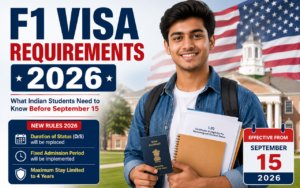
F1 Visa Requirements 2026: What Indian Students Need to Know Before September 15
Planning to study in the United States in 2026? Understanding the F-1 visa requirements is an important step before applying for a U.S. student visa.


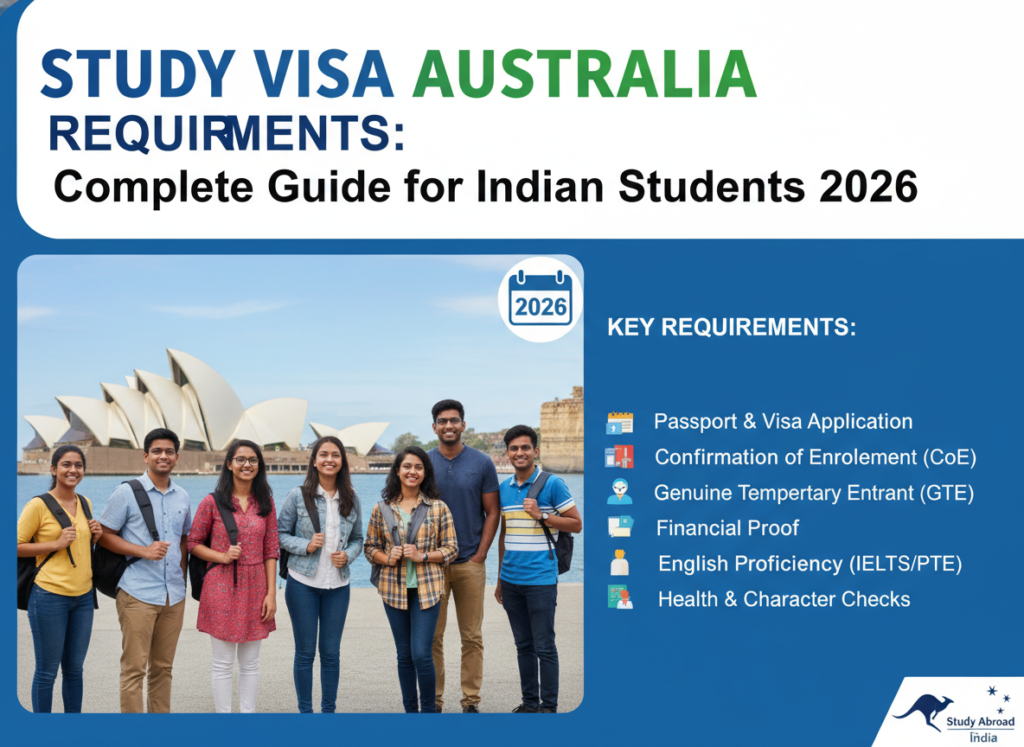
Pursuing education in Australia has become increasingly attractive for Indian students seeking world-class quality education combined with promising career prospects. The study visa Australia requirements have undergone significant changes as of 2025, making it essential to understand the latest eligibility criteria, financial obligations, and application procedures. As of February 2026, India has become the leading country for study visa Australia approvals, with over 2,734 Indian students receiving visas in a single month—surpassing even China.
If you’re considering Australia for your higher education, understanding the Australia student visa process and meeting all mandatory requirements is crucial for visa success. This comprehensive guide covers everything you need to know about the study visa Australia requirements in 2025, including financial capacity, English proficiency standards, and the application timeline. Whether you’re an aspiring undergraduate, postgraduate student, or professional seeking further qualification, we’ll walk you through each step to help you navigate the process successfully.
The Australian student visa (Subclass 500) is the primary visa pathway for international students seeking to study full-time courses in Australia. This temporary visa allows students to reside, study, and work in Australia for the duration of their approved course plus an additional three months. As of 2025, Australia remains one of the world’s top education destinations, hosting approximately 843,000 international students—with India representing approximately 17% of the international student population.
The study visa Australia is available to any student enrolling in a full-time course registered on the Commonwealth Register of Institutions and Courses for Overseas Students (CRICOS). This includes undergraduate degrees, postgraduate qualifications, vocational training, English language courses (ELICOS), and pathway programs at recognized Australian educational institutions.
To qualify for the Australian student visa, you must meet several fundamental eligibility requirements established by the Department of Home Affairs. These Australia student visa requirements have become more stringent since 2024, reflecting the government’s commitment to maintaining education integrity and ensuring genuine student intake.
Mandatory from January 1, 2025: Before submitting your study visa Australia application, you must secure a Confirmation of Enrolment (CoE) from your chosen Australian educational institution. The Australia student visa process requires that your institution confirms your unconditional acceptance into the course. Conditional offers are no longer acceptable under current study visa Australia requirements.
All applicants aged 18+ must provide: – Medical clearance certificate (HAP ID medical examination) – Police clearance certificate from your home country confirming good character – Detailed health history and examination by approved Australian medical practitioners
If you’re under 18 years old when applying, you must have documented welfare arrangements with an approved guardian, relative, or designated care provider in Australia before your visa is granted.
One of the most critical study visa Australia requirements is demonstrating sufficient financial capacity to cover all costs associated with your studies. The Australian Government has significantly increased these requirements as of May 10, 2024, to ensure international students can genuinely support themselves without working excessively.
Applicant Category | Minimum Required Amount (AUD) | Equivalent in INR |
Primary Applicant/Student Guardian | AUD 29,710 | ₹16+ lakhs |
Spouse/De facto partner | AUD 10,394 | ₹5.6+ lakhs |
Dependent child | AUD 4,449 | ₹2.4+ lakhs |
Personal annual income (no dependents) | AUD 87,856 | ₹47+ lakhs |
Personal annual income (with family members) | AUD 102,500 | ₹55+ lakhs |
These amounts represent the study visa Australia financial requirements for covering tuition fees (first 12 months), living expenses, OSHC (health insurance), and return airfare.
Your financial proof must cover:
The Australia student visa process accepts multiple forms of financial proof:
Critical Tip: All financial documents must clearly show a 3-month history. Deposits appearing just before your application will be scrutinized carefully. Manual verification of all financial evidence is now standard practice.
Option 1: Full Funds Evidence Provide complete evidence of 12 months’ tuition fees + living costs + travel + OSHC
Option 2: Annual Income Evidence Provide evidence of personal annual income from employment or business combined with bank statements
As of March 23, 2024, the Australian Government significantly tightened English language requirements for study visa Australia, raising the minimum standards to improve education quality and reduce student vulnerability. These updated Australia student visa requirements now require higher proficiency to reduce the dependence on lengthy English pathway programs.
English Test | Minimum Score | Notes |
IELTS (International English Language Testing System) | 5.5 (overall) | Most common; minimum 5.0 in all bands for some courses |
TOEFL iBT (Test of English as a Foreign Language) | 46 | Internet-based test only; not including Home Edition |
PTE Academic (Pearson Test of English) | 42 | Computer-delivered test |
Cambridge English Advanced (C1) | 162 | Traditional exam option |
Occupational English Test (OET) | ‘B’ in all components | For healthcare and medical professionals |
Duolingo English Test | 105 | Emerging option; accepted by many universities |
Important Note: The Australian Department of Home Affairs does NOT accept online-delivered versions of certain tests, including TOEFL iBT Home Edition, IELTS Online, OET@Home, and PTE Academic Online.
If you don’t meet the study visa Australia requirements for direct entry:
These pathway programs count toward your total course duration for visa purposes under the Australia student visa process.
Individual Australian universities may require higher English scores than the government minimum:
Always check your specific institution’s requirements, as these may exceed the baseline study visa Australia requirements.
As of March 23, 2024, the Australian Government replaced the Genuine Temporary Entrant (GTE) requirement with the Genuine Student (GS) requirement, fundamentally changing how the Australia student visa process assesses applicant intent. This shift from a narrative-based 300-word statement to targeted questions represents a more rigorous evaluation methodology.
Under the Genuine Student requirement, the Department of Home Affairs now asks applicants specific, targeted questions instead of requesting a general statement. You must demonstrate:
GTE Requirement | Genuine Student Requirement |
300-word narrative statement | Targeted specific questions |
Subjective interpretation | Standardized assessment |
Broader assessment criteria | Focused on study intent and ties to home |
Single narrative passage | Multiple targeted responses |
General assessment approach | Risk-based evaluation |
Following the correct Australia student visa process ensures smooth application progression. This study visa Australia guide walks you through each mandatory step implemented by the Australian Department of Home Affairs.
Before applying for your visa, you must: – Receive formal unconditional acceptance from your Australian educational institution – Complete any university application requirements – Provide proof of English proficiency if required – Confirm your course commencement date
Timeline: Allow 2-4 weeks for institution acceptance after submitting your application
Mandatory health insurance requirements: – Obtain OSHC from an approved Australian insurance provider – Coverage must commence on or before your course start date – Minimum coverage for your entire stay – Annual cost: AUD 500-720 (2026 pricing)
Top OSHC Providers: – Medibank International Student Health Cover – BUPA International Student Health Cover – nib International Student Health Cover – Allianz Global OSHC
Online application process: 1. Visit the Department of Home Affairs website (immi.homeaffairs.gov.au) 2. Create your ImmiAccount with email and password 3. Enable two-factor authentication for security 4. Receive your Transaction Reference Number (TRN)
Required information: – Personal details and passport information – Educational background and qualifications – Genuine Student responses to targeted assessment questions – Previous visa history – Health and character declarations
Estimated time: 1-2 hours to complete
Essential documents for study visa Australia** application:**
Educational Documentation: – Confirmation of Enrolment (CoE) from your institution – English test results (IELTS, TOEFL, PTE, or equivalent) – Academic transcripts and certificates – Statement of Purpose/Personal Statement
Financial Documentation: – Bank statements (3+ months history showing genuine funds) – Education loan approval letters – Scholarship documentation – Property deeds or valuations – Proof of parental/sponsor income
Health & Character Documentation: – Medical examination report (HAP ID format) – Police clearance certificate – Character references (if required) – Vaccination records
Identity Documentation: – Valid passport (biographical page + all pages) – Digital passport-quality photographs (51mm × 51mm) – Driver’s license or national identity card
Understanding study visa Australia processing time helps you plan your timeline effectively. The Australia student visa process processing duration varies significantly by education sector and application complexity.
Education Sector | 50% Processed | 90% Processed |
Higher Education (University) | ~21 days | 4-6 months |
Postgraduate Research | ~26 days | 82 days |
Vocational Education & Training | 5 months | 6 months |
English Language (ELICOS) | 8+ weeks | 3+ months |
Non-award/Bridging | 6-8 weeks | 4-5 months |
Important Context: Application times depend on submission complexity, document verification requirements, and medical/biometric processing.
Faster Processing (2-3 weeks): – Complete documentation submission – Straightforward financial verification – No health concerns identified – Clear study pathway alignment – Minimal document requests
Standard Processing (4-8 weeks): – Incomplete initial documentation – Requires financial clarification – Standard medical examination needed – One document request cycle
Longer Processing (8+ weeks): – Multiple document requests – Complex financial arrangements requiring verification – Medical examination complications – Biometric data collection delays – Additional assessment for Genuine Student requirement – Resubmission of documents
Current approval statistics (2025): – Overall approval rate: 85% offshore applicants – Success rate: Up 13.3% compared to 2022-23 – Rejection rate: Approximately 15% – Onshore approval rate: Slightly higher than offshore
Approval rates by country (2025 data): – China: ~92% approval rate – Vietnam: ~83% approval rate – India: Facing stricter scrutiny (~78% average) – Nepal: Stable ~85% approval rate
Why India has lower approval rates: – Increased scrutiny on financial verification – Stricter Genuine Student assessment – Higher percentage of applications from less-established institutions – More document verification requests
The Australian Government has reformed work entitlements for international students to balance earning capacity with study commitment. Understanding these work hours restrictions is crucial for financial planning during your Australia student visa stay.
Period | Allowed Work Hours |
During course study sessions | 48 hours per fortnight (24 hours/week average) |
During official course breaks | Unlimited hours |
Graduate research students (Masters/PhD) | Unlimited hours while engaged in research |
Dependent family members of Master/PhD students | Unlimited hours |
Dependents of other student visa holders | 48 hours per fortnight |
Key Points: – Fortnight definition: 14 consecutive days (typically Monday-Sunday of following week) – Start date: Can only work after course officially commences, not from visa grant date – Holidays: Full semester breaks = unlimited work opportunity
What you CAN do: – Work for multiple employers simultaneously – Work part-time while studying full-time – Work in any occupation (unless banned for skill shortage reasons) – Work self-employed or as a contractor – Work unlimited hours on course breaks
What you CANNOT do: – Work before your course starts – Exceed the 48-hour fortnight limit during study periods – Allow work to interfere with course attendance and progress – Neglect compulsory course requirements – Work full-time while course is in session
Breaching work conditions can result in: – Visa cancellation – Deportation from Australia – Ban on future visa applications – Criminal record implications – Loss of skilled migration opportunity
After completing your study visa Australia course, you’re eligible to apply for the Temporary Graduate Visa (Subclass 485), extending your stay for employment experience.
Qualification | Maximum Duration |
Bachelor Degree (including Honours) | Up to 2 years |
Master’s Degree (coursework) | Up to 2 years |
Master’s Degree (research) | Up to 3 years |
Doctoral Degree (PhD) | Up to 3 years |
Note: Graduates from regional Australia may qualify for additional 1-2 years through the Second Post-Higher Education Work stream.
New restrictions effective 2026: – Age limit for Temporary Graduate Visa applicants: Reduced from 50 to 35 years – Stricter English proficiency requirements – Tighter financial benchmarks – Removal of “bonus years” previously available for city-based graduates
Understanding common rejection reasons helps you strengthen your study visa Australia application and avoid costly mistakes. The Australia student visa process scrutinizes applications for integrity and genuine intent.
Common failures: – Funds appear shortly before application without historical accumulation – Bank statements show gift deposits rather than genuine savings – Education loan approval doesn’t clearly show fund disbursement timing – Financial documents don’t match claimed occupations or income levels – Genuine Student requirement: Insufficient explanation of financial capacity in your country
Prevention: – Accumulate savings 6+ months before application – Provide 3+ months of consistent bank statements – Include detailed supporting documents (employment letters, business registration, tax returns) – Clearly link financial sources to genuine income/assets
Red flags: – Weak explanation for studying in Australia specifically – Course doesn’t align with previous education or career goals – Vague responses to targeted assessment questions – Unclear plans for return to India after graduation – Inconsistency between stated goals and course selection
Prevention: – Provide specific, detailed Genuine Student responses – Show clear career progression from your current qualification to the Australian course – Research the specific course and explain how it differs from Indian options – Articulate strong ties to India and reasons for returning – Address any gaps in educational history directly
Complications: – Tuberculosis or communicable disease diagnosis – Mental health conditions without supporting documentation – Police clearance reveals criminal history – Previous visa cancellation or serious visa breach – Character references raise concerns
Prevention: – Obtain medical clearance well in advance – If health issues exist, provide comprehensive medical documentation – Consult with immigration lawyer if police record exists – Ensure character referees are credible professionals – Full transparency about any previous visa history
Common mistakes: – CoE shows different personal details than passport – Missing or incomplete signatures on forms – Contradictory information across application documents – Expired documents at time of submission – Forged or fraudulent documents (immediate ban)
Prevention: – Triple-check all personal details match exactly – Sign all required sections in blue ink – Verify all documents are current and valid – Use original documents or certified translations – Have consultant review before submission
Issues: – Test results expire before application or don’t meet minimum – Invalid test format (online-delivered test rejected) – English score just below university minimum when study visa Australia requirements satisfied – Fraudulent test score submission
Prevention: – Take IELTS/TOEFL/PTE at recognized test centers – Ensure test date is within 3 years of application – Verify test scores meet both DHA minimums and university requirements – Consider higher score to strengthen application overall
For applicants under 18: – Designated guardian not approved by institution – Welfare arrangement documentation incomplete – Guardian lacks Australian legal residency – Accommodation not confirmed
Prevention: – Arrange welfare with family member in Australia if possible – Work with institution to approve guardian arrangements – Provide comprehensive accommodation documentation – Include guardian contact details and supporting letters
During student visa: – Evidence of work before course commencement – Work exceeding 48-hour fortnight limit – Work preventing course completion
Prevention: – Don’t commence work until course officially starts – Track work hours carefully; maintain records – Prioritize course progress and attendance – Inform employer of work hour limits
A: The minimum IELTS overall score for the study visa Australia is 5.5 (as of March 2024). However, individual universities often require higher scores—typically 6.0-6.5 minimum depending on course. For example, UNSW Sydney and University of Melbourne generally require IELTS 6.5-7.0 for most programs. Always check your specific institution’s English requirements, as institutional standards may exceed the baseline Australia student visa requirements.
A: The minimum financial requirement is AUD 29,710 per year for living expenses, plus first-year tuition fees, OSHC (AUD 500-720), and return airfare. This increased from AUD 24,505 as of May 10, 2024. If you’re a dependent, you need to add AUD 10,394 (spouse) or AUD 4,449 (child) per year. All financial evidence must show a 3-month history of genuine access to funds. Funds appearing shortly before application are likely to trigger additional verification requests.
A: Processing time varies by education sector. For higher education (university), 50% of applications are processed within 21 days and 90% within 4-6 months. Postgraduate research is faster (~26 days for 50%), while VET takes longer (5-6 months for 90%). Your specific processing time depends on document completeness, medical examination requirements, and whether additional information requests are issued.
A: Yes. You can work up to 48 hours per fortnight (approximately 24 hours per week) during course study periods. During official course breaks, you can work unlimited hours. If you’re pursuing a Master’s or PhD, you have unlimited work hours while engaged in your research. You can only start working after your course officially commences, not from visa grant date. Part-time work helps offset living costs, which average AUD 1,500-2,700 monthly.
A: The Genuine Student (GS) requirement, implemented March 23, 2024, replaced the previous Genuine Temporary Entrant (GTE) requirement. Instead of submitting a narrative 300-word statement, you now answer targeted specific questions about your study intent, course selection, career goals, and ties to your home country. GS assessment is more standardized and rigorous, focusing specifically on why you’re studying and why you’ll return home after graduation. This shift aims to prevent fraudulent applications and strengthen the integrity of Australia’s education system.
A: The CoE is official confirmation from your Australian institution that you’re unconditionally accepted into a full-time course. As of January 1, 2025, you must have your CoE before submitting your visa application (if applying from Australia). If applying offshore, you can apply shortly after securing CoE. The CoE confirms course details, fees, commencement date, and expected completion date. Conditional offers are no longer acceptable—you must have unconditional admission.
A: Yes, OSHC is mandatory for all study visa Australia holders for their entire stay duration. It’s a visa condition and cannot be waived. Average OSHC cost is AUD 500-720 annually for a single student (2026 pricing). Providers include Medibank, BUPA, and nib. Most students purchase OSHC as part of their visa application process. Medical expenses without OSHC can be extremely expensive—typically AUD 200-500 per doctor visit.
A: Yes. If you change courses or course duration, you can apply to extend your student visa. Extensions are processed through your ImmiAccount and require updated CoE from your institution. Visa extension applications are typically assessed within 4-8 weeks. You’ll pay an extension application fee (currently AUD 2,000). Ensure you extend before your current visa expires to maintain legal status.
A: After completing your Australian course on a study visa Australia, you can apply for the Temporary Graduate Visa (Subclass 485) to live and work in Australia for 2-3 years (depending on qualification). A Bachelor’s degree qualifies for 2 years; a Master’s or PhD for 2-3 years. This visa allows unlimited work hours in any occupation, helping you gain local Australian work experience—valuable for permanent migration applications or international employment. Approximately 110,000 Temporary Graduate Visas are granted annually.
A: If rejected, you’ll receive a detailed rejection letter explaining the reasons. You can reapply after addressing the issues within the stated timeframe (typically 3-6 months recommended). Before reapplying, consult with a professional immigration consultant to understand specific rejection reasons and strengthen your application. You’re permitted to reapply indefinitely, but patterns of rejection may indicate deeper issues requiring professional guidance. Many rejections are successfully overturned on reapplication with improved documentation.
A: Yes, absolutely. You must declare all previous visa applications, whether approved, rejected, or withdrawn. Concealing this information is visa fraud and can result in permanent bans from Australia. If you have previous rejections, consult an immigration lawyer before applying to address the underlying issues and present a stronger case. Transparency about previous applications, when combined with solutions, often results in approval.
A: Dependent family members can be included on your visa application as secondary applicants. This includes spouse/de facto partner and dependent children under 18 (or up to 23 if dependent). Dependent family members on your visa have their own visa conditions and work entitlements. Bringing dependents increases required financial proof (AUD 10,394 for spouse; AUD 4,449 per child annually). Family members must also meet health and character requirements.
A: Medical conditions that could affect approval include untreated tuberculosis, serious mental health conditions without documentation, communicable diseases, or conditions requiring extensive public healthcare resources. However, having a medical condition doesn’t automatically result in visa rejection. If relevant, provide comprehensive medical documentation, treatment plans, and specialist assessments. Transparency with medical evidence usually results in approval if condition is manageable.
A: Calculate as follows: – Your living costs: AUD 29,710 – Your tuition (12 months): Course-specific fee – Spouse living costs: +AUD 10,394 (if included) – Each child living costs: +AUD 4,449 per year – OSHC for all: +AUD 500-720 each – Return airfare: +AUD 1,500-2,500 total
Example: Single student with spouse studying Commerce at AUD 30,000/year = AUD 29,710 (living) + AUD 30,000 (tuition) + AUD 10,394 (spouse living) + AUD 600 (OSHC) + AUD 2,000 (visa fee) = AUD 72,704 minimum.
A: Your institution must be registered on CRICOS (Commonwealth Register of Institutions and Courses for Overseas Students) to issue valid CoE for study visa Australia applications. If your desired institution isn’t CRICOS-registered, you cannot obtain a student visa for that course. Verify CRICOS registration on the Australian Government CRICOS website before enrolling. Only CRICOS courses are eligible under the study visa Australia requirements.
Sunland Education and Immigration Consultants has been guiding students through the Australian education and visa process since our establishment in 2001. Based in Chandigarh, Sector 32D, we’ve helped thousands of Indian students successfully navigate study visa Australia requirements and begin their educational journey in Australia.
July 2024 Changes: – Visa application fee increased to AUD 2,000 (from AUD 1,600) – Minimum financial requirement increased to AUD 29,710 (from AUD 24,505) – Minimum IELTS raised to 5.5 (from previous lower thresholds)
January 2025 Changes: – CoE now mandatory before submitting onshore applications (previously could apply with conditional CoE) – Genuine Student (GS) replacement of GTE fully implemented – Stricter financial documentation verification protocols – Manual review of all financial evidence now standard
2026 Graduate Visa Changes: – Age limit for Temporary Graduate Visa reduced from 50 to 35 years – Removal of “bonus years” previously extending graduate visas to 6 years – Stricter English proficiency requirements for graduate visas – Tighter financial benchmarks for graduate visa sponsorship
Despite recent visa policy changes, Australia continues attracting Indian students due to exceptional education quality combined with post-study work opportunities. Here’s why thousands of Indian students choose Australia annually:
Australia’s higher education system ranks 3rd globally (after the US and UK) according to QS World University Rankings 2025. Key highlights:
University of Melbourne (Global Rank: #13) – Strongest all-around institution – 53/56 subjects in top 100 globally – International business, engineering, and medicine
UNSW Sydney (Global Rank: #19) – World-leading STEM research – Startup incubator hub – Engineering and technology focus
University of Sydney (Global Rank: #18) – Strong graduate employability – Business and social sciences – 52 subjects in top 100 globally
Australian National University (Global Rank: #30) – Leading research institution – Government and policy studies – Scholarships for Indian students
Course Level | Annual Tuition Range | Typical Duration |
Undergraduate Bachelor | AUD 20,000-45,000 | 3 years |
Postgraduate Master’s | AUD 22,000-50,000 | 1-2 years |
Doctoral/PhD | AUD 14,000-37,000 | 3-4 years |
Vocational/Diploma | AUD 4,000-22,000 | 1-2 years |
Total 3-year Bachelor’s cost estimate: AUD 90,000-135,000 (~₹48-72 lakhs) including living expenses
After completing your study visa Australia course, you’re eligible for:
India’s strong IT and engineering representation in Australian skilled migration confirms quality of Australian education in these fields.
The study visa Australia requirements have evolved to prioritize education integrity and genuine student intent while maintaining Australia’s position as a world-leading education destination. As of 2025, India remains the fastest-growing source market for Australian student visas, with over 5,000 visas granted to Indian students in the first quarter alone.
Understanding current Australia student visa requirements—including the AUD 29,710 financial threshold, updated English standards, and Genuine Student assessment—is essential for success. Your journey to Australian education requires careful planning, thorough documentation, and strategic guidance from experienced professionals.
Sunland Education and Immigration Consultants offers comprehensive support through every stage of your study visa Australia application process. Our 25 years of expertise, 98% approval success rate, and commitment to student welfare make us Chandigarh’s trusted partner for Australian education and immigration pathways.
Don’t let policy changes and complex requirements overwhelm your dreams. With proper guidance, your study visa Australia approval is well within reach. Contact us today for a free consultation and take your first step toward world-class Australian education.
Contact Sunland Education and Immigration Consultants Today
Location: Chandigarh, Sector 32D, India
Services Offered: – Free visa eligibility assessment – Expert guidance on Australia student visa requirements – Complete visa application support – University selection assistance – Pre-departure coaching and orientation
Why Indian Students Trust Sunland: ✓ 25 years of proven expertise (established 2001)
✓ 98% visa approval rate for our guided students
✓ Registered MARA agents and visa specialists
✓ Thousands of successful placements in Australian universities
✓ Transparent, honest consultation approach
✓ Ongoing support even after your visa approval
Don’t let uncertainty delay your dreams. Our expert immigration consultants are ready to guide you through the complete Australia student visa process. From understanding the latest study visa Australia requirements to submitting your final application, we’re with you every step of the way.
Planning to study in the United States in 2026? Understanding the F-1 visa requirements is an important step before applying for a U.S. student visa.
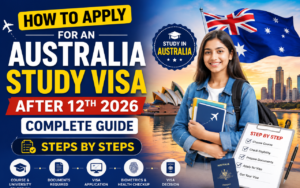
After completing 12th, many students choose Australia for higher education because of its quality education, wide range of courses, and international exposure. If you are
If you are planning to study, work, or settle abroad, preparing for an English language proficiency test can be an important part of your journey.
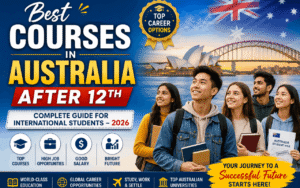
Australia has become one of the most preferred study destinations for international students due to its world-class universities, globally recognized degrees, excellent career opportunities, and
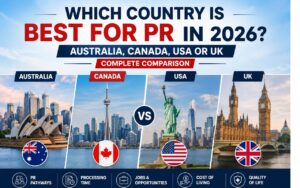
Introduction If you are planning to settle abroad, one of the biggest questions you may have is “Which country is best for PR in 2026?”
Are you searching for the Top Best IELTS Institutes in Chandigarh to achieve your dream of studying, working, or settling abroad? Choosing the right IELTS
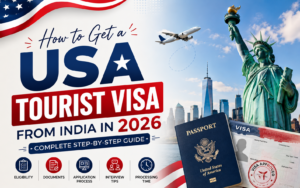
Traveling to the United States is a dream for many Indian travellers. Whether you want to experience the bright lights of New York City, explore
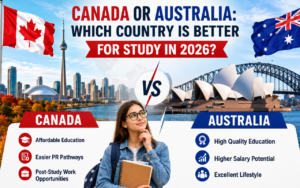
Dreaming of studying abroad but confused between Canada Or Australia? You’re not alone. Every year, thousands of international students face this same decision while planning
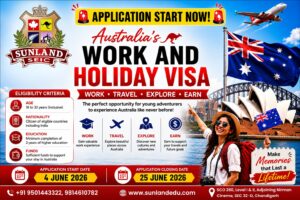
WHM Visa Australia 2026 Work and Holiday Maker (WHM) Visa is one of the most exciting opportunities for young people who want to work, travel

Australia remains one of the most popular destinations for skilled professionals, students, and families seeking a better quality of life. With a strong economy, excellent

Welcome to Sunland Education & Immigration Consultants, Chandigarh (SEIC) which are serving in immigration field from last 23 years .

Copyrights © Sunland Immigration 2025