
Germany has become one of the most popular destinations for international students looking for quality higher education, internationally recognised degrees and a strong academic environment. Students can choose from a wide range of bachelor’s, master’s and doctoral programmes offered by universities and other recognised higher education institutions.
For students planning to study abroad in 2026, understanding the Study Visa Germany requirements is an important part of the preparation process. Admission to a German university is only one part of the journey. Students may also need to meet academic, language, financial, health insurance and immigration requirements before travelling to Germany.
Germany can also be an attractive option for married students. Depending on the individual circumstances and applicable immigration rules, a spouse and children may be able to join the student through family reunification. However, this is not an automatic benefit and separate requirements must be satisfied.
Why Study in Germany in 2026?
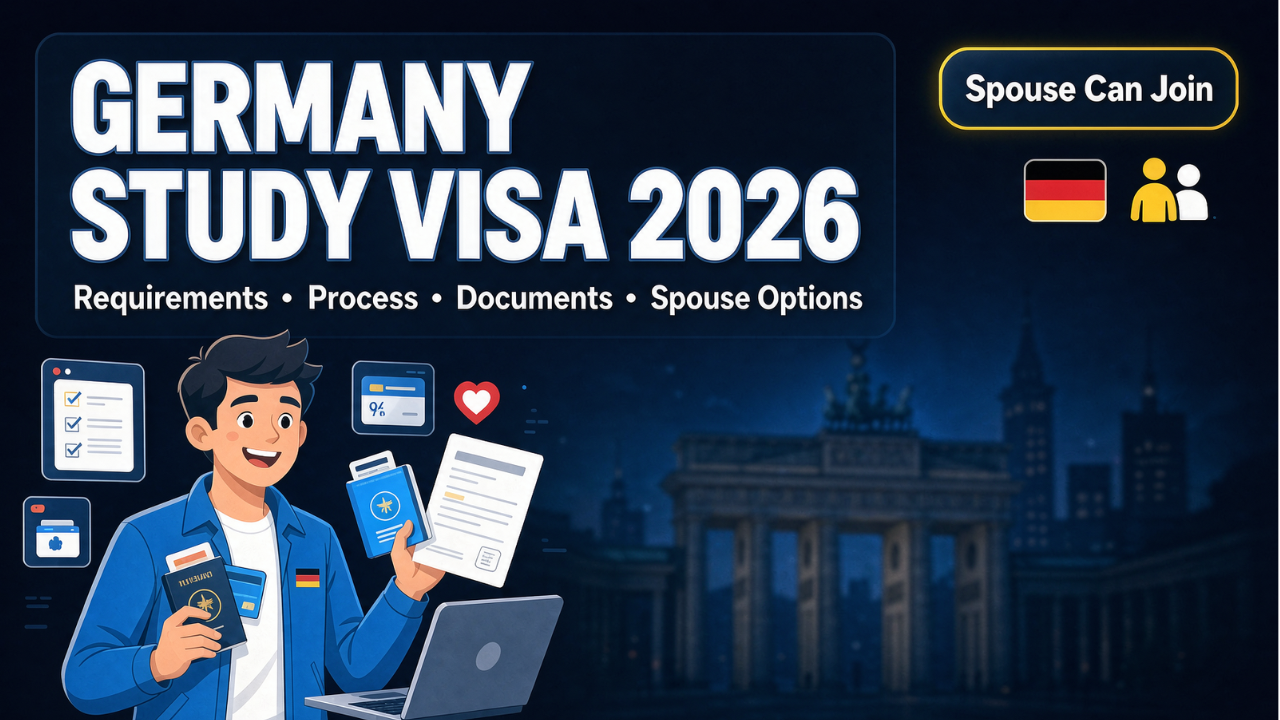
Germany offers international students access to a large and diverse higher education system. Many institutions provide programmes in English, particularly at postgraduate level, while German-taught programmes require appropriate German-language skills.
Some of the major reasons students consider Germany include:
| Benefit | What It Means for Students |
|---|---|
| Quality education | German universities are known for strong academic and research standards |
| Wide range of programmes | Students can choose from numerous fields and specialisations |
| International recognition | German qualifications are valued internationally |
| English-taught courses | Several programmes are available in English |
| Research opportunities | Germany provides strong opportunities for academic and scientific research |
| Student life | International students can experience a multicultural environment |
| Career exposure | Students may gain opportunities to work within the rules applicable to their residence status |
| European location | Germany provides access to many European destinations |
For these reasons, Germany continues to attract students from different parts of the world.
Requirements to Study in Germany
Before starting a Study Visa Germany application, students should first understand the academic and immigration requirements. Requirements can vary depending on the university, programme, nationality and individual circumstances.
The major requirements generally include:
- Choosing an appropriate study programme
- Meeting university admission requirements
- Having the required academic qualifications
- Meeting language requirements
- Preparing university application documents
- Demonstrating sufficient financial resources
- Obtaining appropriate health insurance
- Applying for the relevant visa or residence permission
- Arranging accommodation
- Completing university enrolment after arrival
Let’s understand these requirements in detail.
Also Read More: Complete Guide to Study Visa Aus Nz Uk Canada: Requirements, Costs, Differences, and PR Pathways (2026)
1. Choose a study program in Germany
The first step is to identify a program that matches your academic background, interests, and future plans.
International students can explore bachelor’s, master’s, and doctoral programs in areas such as:
- Business and Management
- Engineering
- Computer Science
- Information Technology
- Data Science
- Artificial Intelligence
- Finance
- Economics
- Natural Sciences
- Social Sciences
- Healthcare
- Architecture
- Environmental Studies
When selecting a programme, check the teaching language, admission criteria, tuition or semester fees, application deadline and required academic qualifications.
Choosing the right programme is also important because your university admission will later form an essential part of your Student Visa for Germany application.
Also Read More: Australia Immigration Updates 2026: Key Visa and Migration Changes Announced on 17 September
2. Germany University Admission Requirements
Every university and program can have its own admission criteria. Therefore, students should check the requirements of the specific institution before submitting an application.
University Entrance Qualification
Students must generally hold an educational qualification that allows them to enter higher education in Germany.
For international qualifications, students can check whether their previous education is recognised and whether additional preparation is required.
Depending on the applicant’s educational background, a preparatory programme such as Studienkolleg may be relevant.
Studienkolleg
Students whose previous school qualification does not directly provide access to their intended university programme may need to complete a preparatory course.
Studienkolleg can help international students prepare academically for higher education in Germany.
TestAS
Some institutions or programmes may require TestAS, an aptitude test designed for international applicants.
However, TestAS is not a universal requirement for every student, so applicants should check the requirements of their selected university and programme.
3. Language Requirements
Language proficiency is another important part of the Germany Student Visa Requirements and university admission process.
The required language depends mainly on the language in which the programme is taught.
German-Taught Programmes
Students applying for German-taught courses may need recognised German-language qualifications.
Depending on the university and programme, certificates such as:
- TestDaF
- DSH
- telc
- Other recognised German language qualifications
may be accepted.
English-Taught Programmes
For English-taught programmes, international students may need to provide evidence of English proficiency.
Commonly accepted tests can include:
- IELTS
- TOEFL
- Other recognised English-language qualifications
The required score depends on the university and programme.
| Programme Type | Possible Language Requirement |
|---|---|
| German-taught programme | German language certificate |
| English-taught programme | English language certificate |
| Bilingual programme | German and/or English depending on course requirements |
| Certain specialised courses | Additional language or academic requirements may apply |
Students should always check the exact language requirement before booking a test.
4. Germany Student Visa Documents
Once you receive admission and prepare for the immigration stage, document preparation becomes extremely important.
Typical Germany Student Visa Documents can include:
- Valid passport
- University admission letter
- Academic certificates
- Academic transcripts
- Proof of language proficiency
- Proof of financial resources
- Health insurance evidence
- Completed visa application
- Biometric photographs
- Proof of accommodation where required
- APS certificate, where applicable
- Other supporting documents requested by the German mission
Applicants from certain countries may have additional document requirements. Students should therefore check the current instructions of the responsible German embassy or consulate.
For applicants from India, document verification requirements such as the APS certificate may be relevant depending on the applicant’s educational background and circumstances.
Document Checklist Table
| Document | Purpose |
|---|---|
| Passport | Identity and travel document |
| Admission letter | Evidence of university acceptance |
| Academic certificates | Evidence of educational qualifications |
| Transcripts | Academic performance record |
| Language certificate | Evidence of required language ability |
| Financial proof | Evidence that living expenses can be covered |
| Health insurance | Required for appropriate coverage |
| Photographs | Visa application requirement |
| APS certificate | Applicable to certain applicants |
| Accommodation evidence | May be requested depending on circumstances |
Having complete and consistent documents can help avoid unnecessary delays.
5. Germany Student Visa Financial Requirements
Financial planning is one of the most important parts of the Study Visa Germany process.
According to the current German government information, students applying for a study residence route in 2026 can generally demonstrate sufficient living funds through options such as a blocked account, scholarship or declaration of commitment. The stated minimum for individual living expenses for studying is €11,904 per year, equivalent to €992 per month in 2026.
Common Ways to Show Financial Resources
| Financial Method | Explanation |
|---|---|
| Blocked account | Money is deposited into a recognised blocked account |
| Scholarship | An eligible scholarship can demonstrate financial support |
| Declaration of commitment | A suitable sponsor in Germany may provide a formal commitment |
| Other accepted evidence | Subject to the requirements of the responsible authority |
Students should not rely on outdated financial figures because required amounts can change.
The financial requirement is particularly important for married students because bringing family members can create additional financial responsibilities.
6. Germany Student Visa Application Process
The Germany Student Visa Process generally begins after the student has secured admission and prepared the required documentation.
The broad process can be understood as follows:
Step 1: Select a University and Programme
Research universities and choose a programme that matches your qualifications and career plans.
Step 2: Apply for Admission
Submit the university application through the relevant university portal, uni-assist or another approved application route.
Step 3: Receive Admission
After meeting the academic requirements, you may receive an admission letter or other confirmation from the university.
Step 4: Prepare Financial Proof
Arrange the required financial evidence, such as a blocked account, scholarship or accepted declaration of commitment.
Step 5: Arrange Health Insurance
Prepare appropriate health insurance evidence according to the applicable requirements.
Step 6: Submit the Visa Application
For applicants who require a visa before entering Germany, the application is submitted through the competent German mission or the applicable online process.
The Federal Foreign Office states that study visa applications can be submitted through the German mission abroad, with documents proving acceptance for studies among the relevant evidence.
Germany’s Consular Services Portal also allows certain visa applications, including study and family-reunification applications, to be started online. Applicants may still need to attend an in-person appointment for biometrics, original-document verification and payment.
Step 7: Attend the Appointment
Depending on the application route, you may need to provide biometrics, submit original documents and answer questions about your studies and plans.
Step 8: Wait for the Decision
Processing times can vary depending on the location, application volume and individual case.
7. Germany Student Visa Fees
The Germany Student Visa Fees should be checked directly with the responsible German mission because visa fees and payment arrangements can be subject to applicable rules and changes.
Apart from the visa fee, students should also budget for:
- University application costs, where applicable
- APS-related costs, where applicable
- Language test fees
- Document translation and certification
- Health insurance
- Blocked account-related charges
- Accommodation
- Travel expenses
- Semester contributions
Therefore, applicants should prepare a complete financial plan rather than focusing only on the visa application fee.
8. Health Insurance for International Students
Health insurance is an essential part of studying in Germany.
International students generally need appropriate health insurance coverage for their stay. Depending on their circumstances and status, students may use statutory or private insurance that meets the applicable requirements.
Before travelling, students should confirm exactly what evidence of insurance is required for their visa and university enrolment.
9. Accommodation in Germany
Finding accommodation before or shortly after arrival is another important part of planning.
Students can consider:
- Student residences
- Shared apartments or WGs
- Private apartments
- University-related accommodation
- Temporary accommodation while searching for a long-term option
Housing costs can vary considerably depending on the city. Major student cities may have higher rents and greater competition for accommodation.
Therefore, students should begin their accommodation search early.
10. Can a Spouse Join a Student in Germany?
This is an important question for married students planning to study abroad.
A spouse may be able to join a student in Germany, but it should not be described as an automatic or guaranteed right simply because one partner has a student visa.
According to the Federal Foreign Office, family reunification for foreign students is generally considered when the student has a residence permit, the marriage existed when the residence permit was granted, the expected stay in Germany is more than one year and the student is able to support themselves and their family without relying on public funds.
Therefore, applicants considering a Germany Student Visa for Spouse should evaluate their individual circumstances before making travel or financial arrangements.
Spouse Visa and Family Reunification
The spouse normally needs to apply for the appropriate family-reunification visa where a visa is required.
The application can involve documents such as:
- Valid passport
- Marriage certificate
- Proof of relationship
- Evidence relating to the sponsor’s residence status
- Financial evidence
- Accommodation evidence
- Other documents requested by the German mission
The exact requirements can vary according to nationality and individual circumstances.
Germany’s official information confirms that family-reunification applications can also be initiated through the Consular Services Portal in applicable cases.
Can the Spouse Work in Germany?
The right to work depends on the residence status granted to the accompanying spouse and the applicable German immigration rules.
For this reason, students should not assume that a spouse automatically receives unrestricted work rights merely because they accompany a student.
Where family reunification is approved and the appropriate residence title is issued, the accompanying spouse’s employment rights should be checked against the conditions of that residence title.
11. What Happens After You Arrive in Germany?
Your journey does not end after receiving the visa.
After arriving in Germany, students generally need to complete several important formalities.
These may include:
- Arranging or confirming accommodation
- Registering their address where required
- Completing university enrolment
- Obtaining or activating appropriate health insurance
- Applying for the required residence permit where applicable
- Opening a bank account if necessary
- Completing university-related formalities
University Enrolment
After receiving admission and entering Germany, students must complete enrolment according to their university’s instructions.
Documents may include:
- Passport
- Admission letter
- Health insurance confirmation
- Proof of payment of semester contribution
- Previous academic documents
- Residence or visa documents
After successful enrolment, the student can receive university-related credentials and access to student services.
Germany Study Requirements at a Glance
| Requirement | Usually Needed? |
|---|---|
| University admission | Yes |
| Academic qualification | Yes |
| Language proficiency | Depending on programme |
| Financial proof | Yes for applicants subject to the requirement |
| Health insurance | Yes |
| Passport | Yes |
| Visa | Depends on nationality and circumstances |
| APS certificate | Applicable to certain applicants |
| Accommodation | Important for planning and may be required as evidence |
| University enrolment | Yes after admission/arrival |
Germany Student Visa Process: Complete Checklist
Before submitting your application, use this checklist:
Academic Checklist
- Select a suitable programme
- Check academic eligibility
- Check university deadlines
- Prepare certificates and transcripts
- Check whether Studienkolleg is required
- Check whether TestAS is required
Language Checklist
Identify programme language
Take IELTS/TOEFL if required
Take German-language test if required
Check minimum score
Financial Checklist
Arrange financial proof
- Prepare blocked account if applicable
- Check the latest required amount
- Prepare scholarship documents if applicable
Visa Checklist
- Complete visa application
- Prepare passport
- Prepare photographs
- Prepare admission letter
- Prepare financial evidence
- Prepare insurance evidence
- Prepare additional documents
- Attend biometrics/interview if required
Family Checklist
- Check whether spouse family reunification is possible
- Check residence-status requirements
Prepare marriage documents - Review financial requirements
- Apply through the appropriate route
FAQs About Study Visa Germany
Is Germany good for international students in 2026?
Yes. Germany offers a wide range of higher education programmes, including many options for international students. However, students should carefully compare universities, programmes, admission criteria, costs and language requirements before applying.
How much money is required for a Germany student visa in 2026?
For study purposes, the German government’s current guidance states a minimum of €11,904 per year, or €992 per month, for individual living expenses in 2026. The actual financial assessment can depend on the applicant’s circumstances.
Do I need IELTS to study in Germany?
Not necessarily. IELTS is commonly used for English-taught programmes, but the exact requirement depends on the university and programme. German-taught courses may require recognised German-language qualifications instead.
Is a blocked account compulsory?
A blocked account is one accepted way to demonstrate financial resources, but it is not necessarily the only method. The official German government information also identifies scholarships and declarations of commitment as possible forms of financial proof.
Can my spouse go to Germany with me?
A spouse may be eligible for family reunification in certain circumstances, but approval is not automatic. The student’s residence status, expected duration of stay, timing of marriage, financial ability and other requirements can be relevant.
Can I work while studying in Germany?
International students with the appropriate residence status may work within the applicable legal limits. Current German government guidance states that students can work up to 140 full days or 280 half-days per year, or up to 20 hours per week under the applicable rules.
How long can a student residence permit be issued for?
According to current government guidance, residence permits for study purposes are generally issued initially for two years and may be extended in certain circumstances if the student has not completed the programme.
Final Thoughts
Germany can be an excellent option for students who want internationally recognised education and a multicultural academic environment. However, successful planning requires more than simply receiving university admission.
Students should carefully prepare their academic documents, language proof, financial resources, health insurance and immigration paperwork before travelling.
The Study Visa Germany process also requires applicants to understand that university admission and immigration approval are separate stages. Similarly, married students should understand that accompanying a spouse is possible in eligible circumstances but is subject to family-reunification rules rather than being an automatic benefit of a student visa.
If you are planning to study in Germany in 2026, start by selecting the right programme, checking the latest Germany Student Visa Requirements, preparing your documents and reviewing the current rules applicable to your nationality and family situation.
For personalised guidance, applicants should always verify the latest requirements with the relevant German university and German mission before submitting their application.